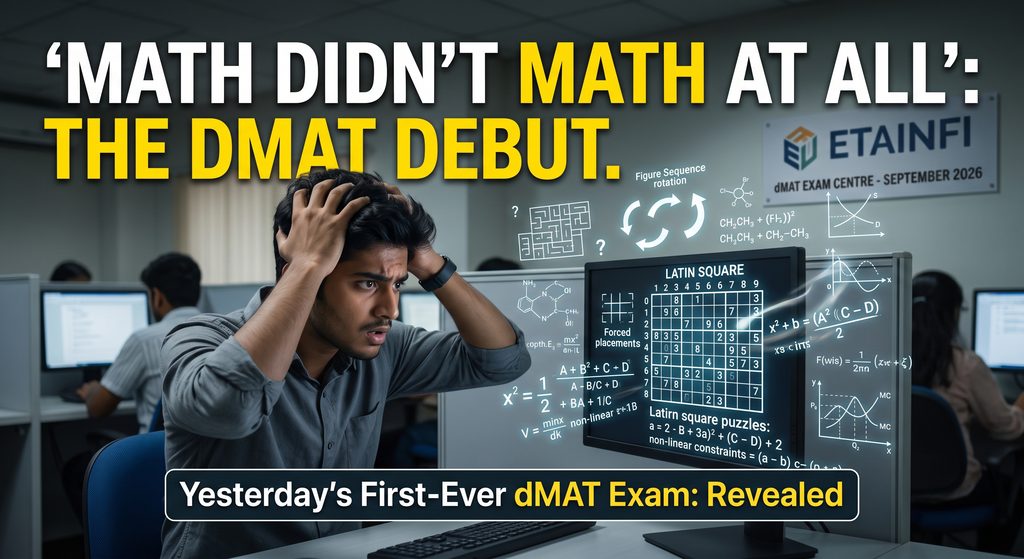
If you walked out of your test centre yesterday feeling shell-shocked, second-guessing your math skills, or wondering if you somehow sat for the wrong paper—take a deep breath.
Across Reddit, WhatsApp applicant groups, and post-exam discussions, the verdict on the September 26, 2026 debut of the Digital Master Test (dMAT) was unanimous: the exam caught almost everyone off guard. Candidates who spent weeks practicing the sample PDF issued by g.a.s.t. e.V. expected a predictable, foundational aptitude screening. Instead, they walked into a high-pressure mental marathon marked by an absolute ban on scrap paper, surprise quadratic equations, and chaotic test-centre management.
Here is an unfiltered, ground-reality look at what students actually experienced across Indian centres yesterday, what questions broke people’s pacing, how eligibility rules play into your strategy, and why your score might be much safer than you think.
How Did Test Centres Handle the Very First Sitting?
The friction started well before the computer screens even flickered on. Because this was the pilot administration under APS India, test centres across Delhi, Bengaluru, Mumbai, and Kolkata faced notable operational teething issues.
Students reported delays ranging from 30 to 45 minutes just to get seated. Venue staff at several third-party testing partners appeared unfamiliar with the specific protocol, sending students bouncing back and forth between document verification desks and computer labs.
The biggest complaint from test-takers? Mid-exam interruptions.
Because APS requires a physical, signed “Declaration of Consent” to transfer test scores, invigilators in centres like Kolkata actually walked around during active, timed modules, demanding signatures and checking identification cards while student timers ticked down. Coupled with ambient room noise and crowded seating, candidates were forced to battle external distractions alongside an already intense countdown clock.
Why Did the “No Scratch Paper” Rule Break the Math Section?
Ask anyone who wrote the exam yesterday which section caused the most grief, and you will hear one resounding answer: Mathematical Equations.
Test administrators strictly enforced a total ban on scrap paper, notebooks, and pens. Every single equation had to be balanced and solved entirely in your head.
That constraint collided head-on with unexpected question design:
- Surprise Quadratic Relationships: While candidates anticipated basic linear substitutions (like $A + B = 15$), the actual test introduced non-linear and quadratic expressions early on.
- Variable Bloat: Equations started with 2 to 3 variables before scaling into dense 4-variable systems, with unknown values constrained as integers from 1 to 20.
- Working Memory Overload: Trying to mentally test factors, hold three variables in your short-term memory, and calculate products simultaneously caused severe bottlenecks.
Multiple candidates on the r/dMATgermany Discussion confessed that after question six, they were guessing: “Math didn’t math at all,” and “hardly 4 to 5 will be correct.”
Were Figure Sequences Really a Visual Ambush?
The logic behind the Figure Sequences subtest was largely what students practiced—elements shifting clockwise, colors flipping, or symbols alternating along a perimeter.
The trap was the answer options.
Instead of presenting distinctly different distractor shapes, the system displayed near-identical “twin” options. Candidates found themselves leaning inches away from their monitors, straining their eyes to catch microscopic differences: a five-degree rotation variance, a slightly shifted inner anchor dot, or an inverted outline stroke.
Because candidates were granted roughly 75 seconds per question (20 items in 25 minutes), spending 45 seconds just cross-examining visual distractors wrecked pacing. By the time the final four questions appeared, many test-takers were clicking blind choices just to beat the clock.
Why Did Latin Squares Turn Out to Be the Unexpected Lifesaver?
Amid the chaos of the Core Module, Latin Squares emerged as the undisputed favorite of the day.
Initial preparation had terrified students because solving a 4×4 or 5×5 grid purely in your head sounded impossible. However, the actual exam questions proved much more forgiving than those in unofficial mock tests:
- High Clue Density: Most grids offered several rows and columns that already had three of the four symbols filled, creating immediate, forced placements.
- Direct Elimination: Students who avoided trial-and-error and instead practiced “reading the cross”—scanning where row and column rules intersected—cleared this section with minutes to spare.
Candidates widely agreed: if you maintained discipline and solved for single-missing-variable cells first, Latin Squares was the easiest scoring opportunity in the entire Core Module.
How Did Candidates React to the General Academic Module?
After a 30-minute break, test-takers returned for the 90-minute General Academic Module—and reactions split right down the middle based on background.
Rather than the 4 brief, straightforward scenarios presented in the introductory sample PDF, the screen served up 10 detailed, multi-paragraph academic case studies, each tied to 6 or 7 questions.
For many applicants, the subject matter felt like an unexpected throwback to 11th and 12th-grade entrance exams:
- The Cross-Discipline Shock: Commerce and business graduates were hit with dense scientific problem sets covering chemical reaction kinetics, thermodynamics, and physics graphs. Meanwhile, engineering and computer science students were tasked with dissecting macroeconomic policy models and corporate governance structures.
- Data-Heavy Synthesis: The questions did not test pure text comprehension; they demanded that you cross-examine graphs, balance data from complex tables, and spot logical inconsistencies.
- Reading Fatigue: Sitting through ten dense, multi-page technical analyses immediately following an exhaustive mental-math section pushed cognitive stamina to its limit. Those who kept a brisk, steady pace found the questions straightforward; those who lingered on early questions ran out of time on the final texts.
Are You Even Required to Take the dMAT?
Before losing sleep over mental quadratic equations or rushing to book the next available slot, you must verify whether your specific academic background actually mandates this exam.
A common misconception circulating in student groups is that every single applicant heading to Germany for a Master’s degree needs the dMAT. In reality, the requirement targets three specific groups: Engineering, Commerce/Accounting/Finance/Economics, and Business/Management.
Crucially, APS evaluates the exact wording on your official degree certificate and transcript, not your university’s promotional brochure:
- Degrees like standalone BCA, BSc Computer Science, BSc IT, architecture, pharmacy, pure sciences, and humanities are generally outside this mandate.
- If your physical APS documents were dispatched or your application completed prior to the June 29, 2026 transitional cutoff, you may already be exempt.
To avoid costly missteps and see exactly where your degree stands under the latest APS guidelines, watch this comprehensive breakdown of dMAT rules, degree eligibility, and exemptions. Getting your eligibility confirmed early will save you weeks of unnecessary stress.
Will a Rough Test Day Wreck Your Admission Chances?
If you walked out feeling like you bombed the Core Module, take comfort in how standardized testing works:
- Relative Normalization Protects You: The dMAT is scored on a standardized curve from 0 to 200, with 100 representing the exact cohort average. Because the entire test cohort struggled with mental quadratics and visual distractors, raw scores will be heavily normalized. Getting 8 or 9 questions right out of 20 in Math could still land you well within a competitive percentile rank.
- APS Does Not Have a “Fail” Mark: For your APS certificate, the dMAT serves as an assessment of academic aptitude, not an elimination barrier. Your score will be transmitted to APS and attached to your profile.
- Universities Look at the Whole Picture: German admission committees weigh your bachelor’s CGPA, curriculum credit compatibility (ECTS matching), and language proficiency far more heavily than a pilot aptitude score.
Official scorecards release on the g.a.s.t. portal on October 12, 2026. Until then, obsessing over raw answers is counterproductive—the curve will do its work.
How Should You Prepare for the Early 2027 Cycle?
The next dMAT window is expected in the first quarter of 2027 (February/March). If you are preparing for that session or planning a retake, your study approach needs to reflect test-day realities:
- Ditch Rough Paper Immediately: Stop doing practice math with a pen. Train your working memory using mental factoring, mental algebra, and dual-variable retention drills.
- Train for High-Glare Visual Fatigue: Practice spatial sequences on a computer screen rather than on paper. Get comfortable scanning fine geometric details without pausing.
- Master Cross-Discipline Reading: If you are an engineer, read international trade reports. If you are an economics graduate, spend 30 minutes a day reading scientific journals and biochemical process diagrams.
Moving Forward With Confidence
Sitting for the very first edition of any national examination takes courage. You were the pioneer cohort, navigating software bugs, test-centre confusion, and brand-new question formats without historical benchmarks. That resilience alone will serve you well when you land in a rigorous German lecture hall.
Navigating German postgraduate admissions—from interpreting your upcoming dMAT percentile and finalizing your APS verification to shortlisting universities that match your exact credit profile—does not have to be a guessing game.
ETAINFI is dedicated to supporting prospective students through every stage of their journey to Germany. Whether you need help understanding how specific universities will evaluate your dMAT score, mapping your bachelor’s degree credits to German prerequisites, or building a competitive application strategy for upcoming intakes, ETAINFI is here to give you straightforward, reliable guidance.