Studienkolleg in Germany can feel like a maze.
One tab for uni-assist. One tab for anabin. One tab for APS. Another one for VPD. Then suddenly you are comparing German certificates, entrance exams, deadlines, visa rules, blocked accounts, housing options, and application portals — all at the same time.
And here is the dangerous part: most students do not lose time because they are lazy. They lose time because they follow the steps in the wrong order.
They choose a Studienkolleg before checking their target bachelor’s degree. They prepare documents but ignore the Aufnahmetest. They apply through the wrong portal. They assume B1 German is enough. Or they pay for a private Studienkolleg without checking if the final certificate will actually be recognised later.
One small mistake can delay your plan by a full semester — sometimes by a full year.
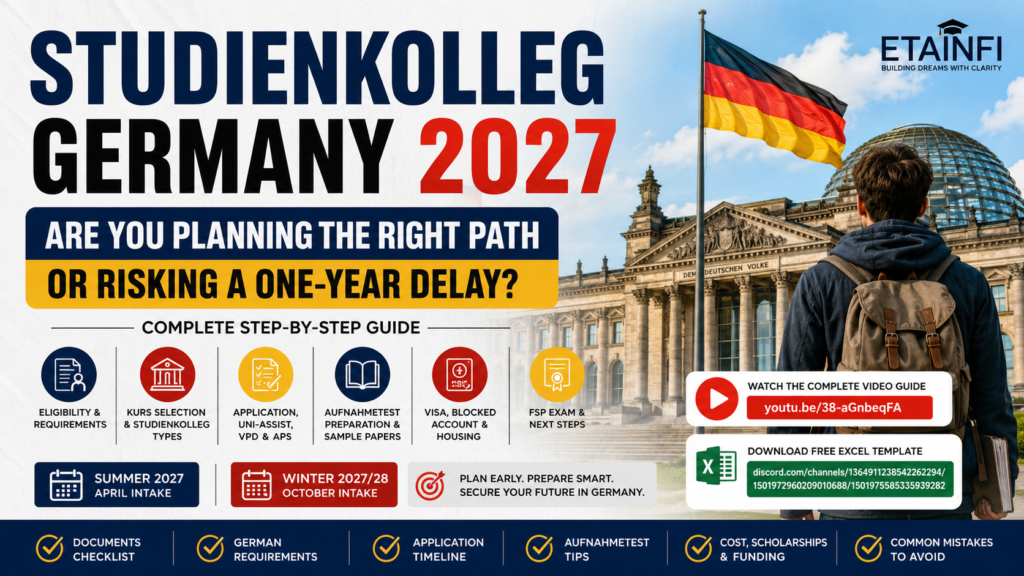
This complete Studienkolleg Germany 2027 guide gives you the roadmap in the correct order: eligibility, Kurs selection, public vs private Studienkolleg, German requirements, uni-assist, VPD, APS, documents, Aufnahmetest, Summer 2027 and Winter 2027 timelines, visa, blocked account, housing, FSP, and the biggest mistakes to avoid.
Prefer watching the full step-by-step explanation?
You can watch the complete video guide here: Studienkolleg Germany 2027: Complete Step-by-Step Guide
I also created a free Studienkolleg 2027 Shortlist and Timeline Excel template to help you compare Studienkollegs, track deadlines, map your Kurs, monitor documents, and plan your next action clearly. You can download it from the EtaInfi Discord here: Download the Excel Template from Discord
What Is Studienkolleg and Why Does It Matter Before Your Bachelor’s Degree?
Studienkolleg is your academic bridge into a German bachelor’s degree when your school qualification is not considered directly equivalent to the German Abitur.
It is not a bachelor’s degree. It is not a guaranteed university seat. And it is not just a German language course.
Studienkolleg prepares international students for academic study in Germany. During this preparatory programme, you study German plus subject-related academic content based on your future field.
At the end, you take the Feststellungsprüfung, usually called the FSP.
If you pass the FSP, you receive a subject-specific higher education entrance qualification for Germany.
That phrase is important: subject-specific.
It means your Studienkolleg track must match your future bachelor’s direction. If your goal is engineering, medicine, business, humanities, or language-related studies, the Kurs you choose now decides which doors may open later.
Do You Actually Need Studienkolleg in Germany?
Not every international student needs Studienkolleg. This is the first thing you must verify before building your plan.
When Germany evaluates your school-leaving qualification, there are usually three possible outcomes.
The first outcome is direct admission. This means your school certificate may allow you to apply directly to bachelor’s programmes in Germany. You still need to meet programme requirements such as language level, grades, deadlines, and subject criteria, but Studienkolleg may not be necessary.
The second outcome is Studienkolleg required. In this case, your school certificate is not enough for direct bachelor’s admission, but you are eligible to complete Studienkolleg, pass the FSP, and then apply for a bachelor’s degree.
The third outcome is not yet eligible. This can happen depending on your country, school board, subjects, grades, or qualification type. In that case, you may need additional academic study in your home country or another verified route before applying.
This is why you should not blindly follow advice like “everyone after school can go to Studienkolleg.”
Germany does not evaluate every student the same way. Your pathway depends on your country, qualification, subjects, grades, and target institution.
How Can You Check Your Studienkolleg Eligibility Correctly?
The fastest way to reduce confusion is to check your eligibility through serious sources, not random comments, WhatsApp groups, or social media shortcuts.
Start with the uni-assist “Check: university admission” tool. It gives you an orientation based on your country and school certificate. It can show whether your qualification usually leads to direct admission, Studienkolleg, or another requirement.
Then check anabin, the official German database for foreign educational qualifications. It is not the most user-friendly platform, but it helps you understand how Germany classifies school certificates from different countries.
Finally, check the official page of your target university or Studienkolleg. This is where the real details usually appear: German level, application route, deadline, required documents, entrance exam subjects, and whether APS or VPD is needed.
Use general tools for orientation. Use the institution’s official application page for your final decision.
Why Should You Start With Your Target Bachelor’s Degree Instead of the Studienkolleg?
The smartest students do not start by asking, “Which Studienkolleg should I choose?”
They start with a better question:
Which bachelor’s degree do I want after Studienkolleg?
Your target bachelor’s field decides your Studienkolleg Kurs. Not the other way around.
Here is the general mapping:
| Studienkolleg Kurs | Typical Future Field |
|---|---|
| T-Kurs | Engineering, Computer Science, Maths, Physics, Natural Sciences |
| M-Kurs | Medicine, Biology, Pharmacy, Dentistry, Life Sciences |
| W-Kurs | Business, Economics, Management, some Social Sciences |
| G-Kurs | Humanities, German Studies, History, Philosophy |
| S-Kurs | Language-related programmes |
But do not treat this table as a universal guarantee.
Some subjects are tricky. Political science, psychology, architecture, design, data science, and social sciences may not always fall exactly where you expect.
The safest method is simple: choose your target bachelor’s programme first, check which Studienkolleg Kurs that university requires for that subject, and then shortlist Studienkollegs offering that Kurs.
Work backwards from the bachelor’s degree. Do not guess forward from the Kurs.
What Is the Difference Between University Studienkolleg and FH Studienkolleg?
This decision can shape your future bachelor’s options, so do not choose casually.
A University Studienkolleg is connected to a classical research university. If you complete the final exam through a university Studienkolleg, you can usually apply to universities and universities of applied sciences, depending on your subject-specific qualification.
An FH Studienkolleg is connected to a Fachhochschule or University of Applied Sciences. These institutions are more practical and industry-oriented. If you complete an FH Studienkolleg, your pathway usually leads to universities of applied sciences, not necessarily classical universities.
The course names can also look different.
Instead of T-Kurs, you may see TI-Kurs.
Instead of W-Kurs, you may see WW-Kurs.
Some FH routes may include GD-Kurs for design or SW-Kurs for social work.
Before you choose, ask yourself this:
After Studienkolleg, do I want to apply to a classical university, a university of applied sciences, or both?
That answer should guide your decision from the beginning.
Should You Choose a Public or Private Studienkolleg?
Public Studienkollegs are attractive because they are usually tuition-free. You may still pay a semester contribution, and you still need money for rent, food, health insurance, transport, documents, and daily life, but there is usually no tuition fee.
The challenge is competition.
Public Studienkollegs have limited seats, and many students apply. The Aufnahmetest often becomes the real filter.
Private Studienkollegs may offer more flexibility, different intake options, and sometimes an easier entry route. But they can cost significant money, and recognition becomes the key issue.
Before paying any private Studienkolleg, ask very specific questions:
Is the FSP state-recognised?
Is the final certificate accepted beyond one institution?
Can graduates apply to public universities later?
Which public universities have accepted graduates before?
What happens if you fail the FSP?
Are there hidden exam fees?
What is the refund policy?
What visa support documents do they provide?
Do not accept vague promises.
Ask for names, proof, and clear written answers. A private Studienkolleg can be a valid option, but only after you verify recognition.
How Important Is German for Studienkolleg?
German is not a small requirement in Studienkolleg. It is the language of the classroom, the exam, the instructions, the teacher’s explanation, and often your written answers.
Even if your dream is an English-taught bachelor’s degree later, Studienkolleg itself is normally taught in German.
So the real question is not:
“Can I study my bachelor’s in English?”
The real question is:
Do I qualify for direct admission without Studienkolleg?
If yes, you may search for English-taught bachelor’s programmes. If no, and Studienkolleg is required, German usually becomes part of the pathway.
Some Studienkollegs may formally accept B1 German. Others may require B2. But here is the practical truth:
Your certificate opens the door. Your real German ability helps you survive inside.
Certificate German and classroom German are not the same.
A B1 certificate may help you apply, but during Studienkolleg you must understand maths, physics, biology, economics, academic texts, exam instructions, and classroom discussions in German.
So even if B1 is accepted, build toward strong B2 ability. Focus on reading comprehension, listening under pressure, academic writing, and subject-specific vocabulary.
What Are APS and Country-Specific Requirements?
APS does not apply to every student, but for some countries it is non-negotiable.
APS stands for Academic Evaluation Centre. It verifies the authenticity of academic documents and educational background for students from countries such as India, China, and Vietnam.
APS is not admission. APS is verification.
The Studienkolleg or university still makes the actual admission decision.
For Indian students planning Studienkolleg Germany 2027, one important point is that updated criteria apply from Winter Semester 2026/27 onward, including a minimum overall score of 70% in Class XII for the Studienkolleg pathway.
If you are from India, check your percentage, APS eligibility, and latest official APS criteria before you build your application plan.
If you are from another country, do not copy India’s process or any other country’s process. Your evaluation rules may be completely different.
Which Application Route Should You Follow for Studienkolleg?
This is where many prepared students still lose months.
Not every Studienkolleg application goes through uni-assist.
Some applications go through uni-assist. Some go through the university’s own portal. Some allow direct application to the Studienkolleg. Some use a separate Studienkolleg-specific process.
Even if a university uses uni-assist for normal bachelor’s applications, the Studienkolleg process may be different.
For each Studienkolleg on your shortlist, write down six things:
Application portal
Deadline
Required German level
Documents needed
Entrance exam subjects and exam date
Recognition of the final FSP certificate
This single habit can save your entire timeline.
Do not assume. Open the official “Bewerbung” or “Application” page and follow the exact route for that institution.
What Is VPD and When Do You Need It?
VPD stands for Vorprüfungsdokumentation, or preliminary review documentation.
Think of it like this: uni-assist checks your foreign academic documents and creates a preliminary evaluation document for the university. It explains how your documents are assessed for that application process.
But VPD is not automatically required for every Studienkolleg application.
Some universities require VPD later for bachelor’s applications. Some require it before Studienkolleg. Some use uni-assist directly without a separate VPD step. Others have a completely different process.
Two common statements are both wrong:
“Studienkolleg always means VPD.”
“VPD is never needed for Studienkolleg.”
The correct answer is:
VPD depends on the university, application stage, and route.
If your target institution asks for VPD, apply early because processing takes time. If it does not ask for VPD, do not create unnecessary steps.
How Should You Find and Shortlist Studienkollegs Properly?
A strong shortlist begins with verified information, not random Google results.
Start with the official register of German Studienkollegs. This list shows the name of the Studienkolleg, federal state, city, status, offered courses, website, and contact details.
Then build your shortlist in this order:
Target bachelor’s degree
Required Studienkolleg Kurs
University route, FH route, or both
Public, private, state-run, or state-recognised status
Application route
Deadline
German requirement
Aufnahmetest subjects
City and housing reality
Do not shortlist by city first.
Berlin, Munich, Frankfurt, and Hamburg may sound exciting, but if the Studienkolleg does not offer your required Kurs, the city does not matter.
Your spreadsheet becomes your control room. Track each Studienkolleg side by side: Kurs, deadline, application portal, German level, entrance exam, VPD, APS, fees, recognition, housing risk, and next action.
To make this easier, I prepared a free Studienkolleg 2027 Excel template for students. Instead of starting with a blank sheet, you can use it to track your shortlist, deadlines, German requirements, Aufnahmetest subjects, APS or VPD status, housing risk, fees, and next steps in one place.
You can download it inside the EtaInfi Discord here: Get the Studienkolleg Excel Template
Once everything is visible, confusion drops.
You can immediately see which option is too expensive, which has the wrong Kurs, which requires B2, which has an early deadline, and which private provider needs recognition proof before payment.
Which Documents Do You Need for Studienkolleg Applications?
Every institution has its own checklist, so do not prepare one random “Germany documents” folder and assume it works everywhere.
Some institutions ask for certified copies. Some accept scanned uploads first. Some require documents in German or English. Some require certified translations. Some ask for originals later by post.
In general, you may need:
Passport
School leaving certificate
Grade transcripts or mark sheets
Proof that your certificate allows higher education in your home country, if required
German language certificate
APS certificate, if applicable
Certified translations, if required
CV, if requested
Motivation letter, if requested
Completed application form
Proof of application fee payment, if applicable
Passport photo, if required
Institution-specific forms
The most common delay is not always a missing document. Often it is the wrong format: a phone photo instead of a certified copy, an unofficial transcript instead of an official one, or a free online translation instead of a certified translation.
Read the checklist carefully. Then read it again.
How Should You Plan for Summer Semester 2027?
Summer Semester 2027 is the urgent route.
If you want to start Studienkolleg around April 2027, you need structure from mid-May or June 2026.
By the end of June 2026, you should know your eligibility, target bachelor’s field, likely Kurs, German situation, and first shortlist.
In July 2026, build a real shortlist of three to five strong options plus backups. Track application route, deadline, German level, documents, entrance exam subjects, exam date, and official source link.
In August 2026, move into document preparation and German checkpoint mode. You should know whether you need B1 or B2 and whether you can realistically reach that level before the deadline.
Start downloading Aufnahmetest sample papers now, not at the last minute.
From September to November 2026, many summer intake routes may already become serious. Some deadlines may come earlier than expected, so do not rely on one general date from the internet.
December 2026 to January 2027 should be your final deadline and entrance exam preparation phase. Your documents, German certificate, and application route should not still be unclear.
February to March 2027 becomes the pressure zone: admission results, visa, blocked account, health insurance, and housing.
If Summer 2027 does not work out, do not panic. Learn exactly which link broke — German, documents, shortlist, Aufnahmetest, visa timing, or recognition — and fix it for Winter 2027.
How Should You Plan for Winter Semester 2027/28?
Winter Semester 2027/28 is the safer planning route for many students starting in mid-2026.
But safer does not mean slow.
By June 2026, you should check eligibility, choose your target bachelor’s field, map your Kurs, begin German seriously, and create your shortlist spreadsheet.
From July to August 2026, reduce confusion. Identify public Studienkollegs, private options worth checking, realistic cities, German requirements, and Aufnahmetest subjects. Start subject vocabulary in German early.
From September to November 2026, collect documents, check translation rules, begin APS if required, plan your German certificate attempt, and download sample papers.
By December 2026 to February 2027, you should have your German exam booked or completed, documents collected, shortlist narrowed, application routes understood, and Aufnahmetest preparation active.
In March and April 2027, check official pages again because some winter application windows may open early.
May and June 2027 are serious application months. This is when many students should be submitting applications, not just researching.
July 2027 is the deadline pressure month for many routes. If you discover missing translations, VPD requirements, wrong portals, or missing German certificates in July, your timeline can collapse.
August and September 2027 often bring entrance exams, results, visa pressure, and housing pressure.
October 2027 is the start of the winter semester — but it is also the start of the actual Studienkolleg year, not the finish line.
Why Is the Aufnahmetest the Real Filter?
For many public Studienkollegs, documents only get you to the first door. The Aufnahmetest decides who actually gets a seat.
Depending on the Studienkolleg and Kurs, the entrance exam may test German, mathematics, physics, economics, biology, chemistry, or subject-specific reasoning.
T-Kurs students should expect serious mathematics and often physics.
W-Kurs students may face German, maths, economics, and business reasoning.
M-Kurs students may see biology, chemistry, maths, or science-based German vocabulary.
G-Kurs and S-Kurs students usually need strong German language ability and language-related reasoning.
Do not prepare only grammar.
Do not prepare maths only in your home-country style.
Prepare German-language tasks under time pressure.
The Aufnahmetest asks three things at once: Can you understand the German? Can you solve the subject problem? Can you perform under exam conditions?
That is why preparation must start early.
How Can You Prepare for the Aufnahmetest Properly?
Start with official sample exams from Studienkolleg websites wherever available. These are far more useful than random practice sheets because they show the real exam style.
Then build exam vocabulary, not random vocabulary.
For T-Kurs, learn words like Gleichung, Funktion, Ableitung, Winkel, Fläche, Volumen, Geschwindigkeit, Kraft, Spannung, and Bruch.
For W-Kurs, learn words like Angebot, Nachfrage, Kosten, Gewinn, Umsatz, Markt, Unternehmen, Preis, Wachstum, and Haushalt.
For M-Kurs, learn words like Zelle, Gewebe, Stoffwechsel, Säure, Base, Reaktion, Organ, Kreislauf, Atmung, and Zellteilung.
Then practise with a timer. Solve under exam conditions. Write your solutions directly in German instead of translating from your native language.
Your goal is not perfection.
Your goal is to make sure the exam does not shock you.
What Happens During Studienkolleg?
Studienkolleg usually lasts around one year and is divided into two semesters. In exceptional cases, very strong students may shorten the period. If performance is not sufficient, a semester can often be repeated once.
During Studienkolleg, you study German and subject-specific academic content.
T-Kurs may include German, mathematics, physics, and technical or scientific subjects.
W-Kurs may include German, mathematics, economics, business, and social science-related content.
M-Kurs may include biology, chemistry, physics, mathematics, and German.
G-Kurs and S-Kurs often focus deeply on German, literature, history, humanities, or language-related subjects.
But Studienkolleg is not only about content.
It teaches you how German academic life works: how to read exam questions, explain concepts, write arguments, solve problems, and study in a system that may feel very different from home.
Many students see Studienkolleg as a delay.
In reality, if you genuinely need it, it can protect you from entering a German bachelor’s degree unprepared.
What Is the FSP and What Happens After Passing It?
At the end of Studienkolleg, you take the Feststellungsprüfung, or FSP.
If you pass, you receive a subject-specific entrance qualification for German higher education. But passing the FSP does not mean automatic admission into a bachelor’s programme.
You still need to apply. You still need to meet deadlines. You still need to compete for limited-admission programmes. Your grades may still matter.
Think of the FSP as the qualification that allows you to apply — not a reserved bachelor’s seat.
And remember: your FSP is connected to your Kurs.
If you complete T-Kurs, you are not automatically qualified for every possible bachelor’s field. The Kurs must match your future study direction.
Can You Take the External FSP Instead of Attending Studienkolleg?
External FSP exists in some cases, but it is not an easy shortcut.
It means taking the Feststellungsprüfung without attending the full Studienkolleg course. That may sound faster, but it requires strong academic German, strong subject knowledge, and a clear understanding of the exam expectations.
For most students coming directly from school, the full Studienkolleg route is more realistic because it provides structure, curriculum, classroom exposure, and preparation.
External FSP can work for highly prepared students, but it is not a magic bypass.
How Should You Plan Visa, Blocked Account, and Money?
If you are a non-EU student, you will generally need a student visa or a national visa for higher education preparation.
A blocked account, or Sperrkonto, is often required to prove that you can financially support yourself in Germany.
As of 2026, the yearly amount is around €11,900, but this number can change. Always check the latest requirement before your 2027 visa application.
You may also need:
Admission or invitation letter
Valid passport
Health insurance
Academic documents
German language certificate
Proof of financing
Visa application forms
Biometric photos
Visa fee
Appointment waiting times vary by country, and in some places they can be long.
Do not wait until admission to understand the visa process. Understand it early, then act quickly when your admission or invitation arrives.
What Should You Know About Housing in Germany?
Housing can become one of the biggest shocks for new international students.
Germany does not have unlimited affordable rooms waiting near every university. Cities like Munich, Berlin, Hamburg, Frankfurt, Cologne, Heidelberg, Stuttgart, Darmstadt, and many university towns can be highly competitive.
Student dormitories often have waiting lists. WG rooms can take weeks to secure. Temporary accommodation can become expensive.
When shortlisting Studienkollegs, include housing reality in your decision.
Check rent levels, dorm options, public transport, distance from affordable areas, and temporary accommodation possibilities.
Germany is manageable, but only if you plan early.
The students who struggle most are often the ones who start searching for housing after the visa is approved.
What Does Studienkolleg Really Cost?
Public Studienkolleg is usually tuition-free, but Germany is not free.
You need to budget for semester contribution, rent, food, health insurance, transport, books, study materials, visa fees, APS fees if applicable, application fees, translations, travel, blocked account, and an emergency reserve.
Food may cost around €200 to €300 per month depending on your habits. Student health insurance may cost around €100 to €120 per month, depending on provider and rules. Rent varies heavily by city and is usually the biggest monthly expense.
Private Studienkollegs can charge tuition fees, sometimes several thousand euros or more.
Do not build your financial plan around working from day one.
Studienkolleg is academically demanding, and students are often restricted from working during the semester. Always verify your visa and residence permit rules before relying on part-time work.
What Is Changing for Studienkolleg Germany 2027 Students?
Germany remains attractive for international students, but the pathway is becoming more competitive and more specific.
More students are applying. Public routes are competitive. Some institutions are updating criteria. Application systems are becoming more detailed. Deadlines, portals, German levels, and document formats can differ sharply from one Studienkolleg to another.
This means generic advice is becoming less useful.
The 2027 advantage goes to students who are early, precise, and verified.
You do not need to know everything on day one. But you must stop guessing and start building a system.
Which Studienkolleg Mistakes Delay Students by One Year?
The biggest mistakes are usually avoidable.
Choosing the wrong Studienkolleg Kurs can block your future bachelor’s route.
Thinking a German certificate equals real German readiness can hurt you in the Aufnahmetest and classroom.
Applying through the wrong portal can make you miss the correct process entirely.
Treating a general deadline as your real planning date can leave you too late for documents, VPD, APS, or translations.
Underestimating the Aufnahmetest can stop you even after a good application.
Assuming VPD is always required or never required creates unnecessary confusion.
Applying to only one Studienkolleg is risky because public seats are competitive.
Shortlisting by city instead of pathway creates emotional but weak choices.
Paying private Studienkolleg fees without recognition proof can become an expensive mistake.
Thinking FSP guarantees bachelor’s admission can create false expectations.
Avoid these ten mistakes and you are already ahead of many applicants.
What Should Your Personal Studienkolleg Action Plan Look Like?
Start with your country and school qualification.
Check whether your qualification leads to direct admission, Studienkolleg, or another requirement using uni-assist, anabin, and official institution pages.
Choose your target bachelor’s field. Be specific. Do not write “engineering” if you actually mean mechanical engineering or computer science.
Map that bachelor’s field to the correct Studienkolleg Kurs.
Shortlist three to five Studienkollegs offering that Kurs. Prefer public routes first, and consider private options only after verifying recognition.
For each option, track the application portal, deadline, German level, documents, entrance exam subjects, VPD, APS, fees, housing risk, and next action.
Start German preparation immediately. Build subject vocabulary alongside grammar.
Prepare for the Aufnahmetest with official sample papers, time pressure, and German-language solutions.
Collect documents early and follow each institution’s checklist exactly.
Understand visa, blocked account, health insurance, and housing before admission comes.
After Studienkolleg, prepare for the FSP and then the bachelor’s application process.
That is the full chain.
Are You Ready to Build Your Studienkolleg Germany 2027 Plan?
Studienkolleg is not the final goal. Your bachelor’s degree is the goal. Studienkolleg is the bridge that gets you there when direct admission is not possible.
If you plan it correctly, it can save you confusion, protect you from wrong decisions, and prepare you for real academic life in Germany.
Start with eligibility. Choose your target bachelor’s. Map the right Kurs. Verify the application route. Prepare German seriously. Respect the Aufnahmetest. Check VPD, APS, documents, visa, blocked account, housing, and costs before they become emergencies.
And most importantly: do not keep this process in your head. Put it into a system.
You can watch the complete video breakdown here: Watch the full Studienkolleg Germany 2027 guide
You can also download the free Studienkolleg 2027 Shortlist and Timeline Excel template from the EtaInfi Discord here: Download the Excel Template
At EtaInfi, we help international students understand Germany with clarity, structure, and honest guidance. If you are planning Studienkolleg Germany 2027, use this roadmap as your starting point — and keep learning before you take the next step.
Your future in Germany does not need to begin with confusion.
It can begin with a verified plan.