Most students who miss Germany’s summer intake don’t miss it because they were lazy. They miss it because they started in November thinking January was still fine — and by then, the APS delay had already eaten their timeline, their documents weren’t ready, and their target course turned out not to offer a summer start at all.
If you’re aiming to begin studying in Germany by April 2027, your countdown doesn’t start in December. It starts right now.
This guide walks you through every step — the exact month-by-month timeline, which documents to prepare when, how to build a smart university shortlist, and the five questions students ask every single week. Whether you’re coming from Asia, Africa, or anywhere else in the world, this roadmap is built for you.
And if you want to watch the full 14-minute breakdown with real on-ground experience, check out the complete video guide on YouTube here →
What Is Germany’s Summer Intake — and Why Does It Catch Students Off Guard?
Germany runs two main intakes every year. The winter semester typically starts in September or October. The summer semester starts in March or April — TU Munich, for example, lists Summer Semester 2027 from 1 April 2027, with lectures beginning on 12 April.
But here is what most guides skip over: summer intake is not the main intake. Winter is.
More courses run in winter. More bachelor’s programs start in winter. More seats, more orientation events, more scholarship cycles. Summer intake is a smaller door — and if you want to walk through a smaller door, your preparation, timing, and shortlisting all have to be sharper.
That doesn’t make summer a worse option. It makes it a more precise one. Treat it accordingly.
Is Summer Intake 2027 Actually the Right Move for You?
Before you open a single university website, answer this honestly: are you ready enough for summer intake?
Summer intake is a strong fit if you are in your final year or have already graduated, if your documents can realistically be ready before November 2026, if your target course genuinely offers a summer start, and if you are mostly applying to master’s programs and don’t want to wait until Winter 2027.
It may not be the right move if your equivalency check — APS for Indian students, NARIC, WES, or equivalent for other nationalities — hasn’t started yet. The same applies if your language exam isn’t planned, your final transcripts are delayed, or your target course only opens in winter. Bachelor’s applicants expecting the same range of options as winter will also find the summer pool significantly narrower.
Knowing this now saves you three months of effort pointed in the wrong direction.
Bachelor’s or Master’s — Why This Distinction Changes Everything
This is the point most YouTube videos and blog posts gloss over, and it causes real damage to applications.
Summer intake in Germany is primarily useful for master’s applicants. For bachelor’s programs, many universities simply don’t offer a first-semester summer start at all. KIT’s bachelor’s programs begin only in the winter semester. The University of Stuttgart explicitly states that no admission to bachelor’s programs takes place during the summer semester. This pattern holds across a large number of institutions.
Searching “summer intake Germany bachelor” will return results that mislead you. Instead, go directly to the course page — not the university homepage, not the department page — and look for the specific line that reads: “First-semester start in summer: Yes or No?”
There’s another trap here. Some universities accept summer applications for higher semesters only, meaning transfer students who are already enrolled somewhere else. That is completely different from starting at semester one. The university name is not enough. The course name is not enough. You need to verify the exact starting semester for your exact course.
What Are the 5 Questions Students Ask Every Week About Summer Intake?
Can I apply with 7th-semester transcripts?
Usually yes. Most master’s programs allow final-year students to apply with current transcripts. But some require the final degree certificate before enrollment begins. Add a column to your Excel shortlist that asks: “Final degree required at application or at enrollment?” The answer varies by program and it matters.
Is IELTS enough for all programs?
That’s the wrong question. The right question is: what is the teaching language of my exact course? English-taught programs generally accept IELTS or TOEFL. German-taught programs require TestDaF, DSH, Goethe, telc, or another recognised German language certificate. Check this per course, not per university.
What’s the difference between uni-assist and a VPD?
Sometimes uni-assist processes and forwards your full application to the university. Sometimes it only checks your documents and issues a VPD — a preliminary document review — after which you still need to apply separately through the university’s own portal. These are two different routes. Record the exact application route for each program in your Excel tracker.
What if my APS or equivalency check is delayed?
Some universities allow conditional application steps, but building your strategy around hope is not a plan. APS and equivalency checks are serious gatekeepers. Start the process in June 2026. Not December.
Is summer intake easier to get into?
Not automatically — and sometimes the opposite is true. With fewer programs available, the competition for the good ones can be just as fierce. Your goal should never be “easier university.” Your goal is the right profile match for your background.
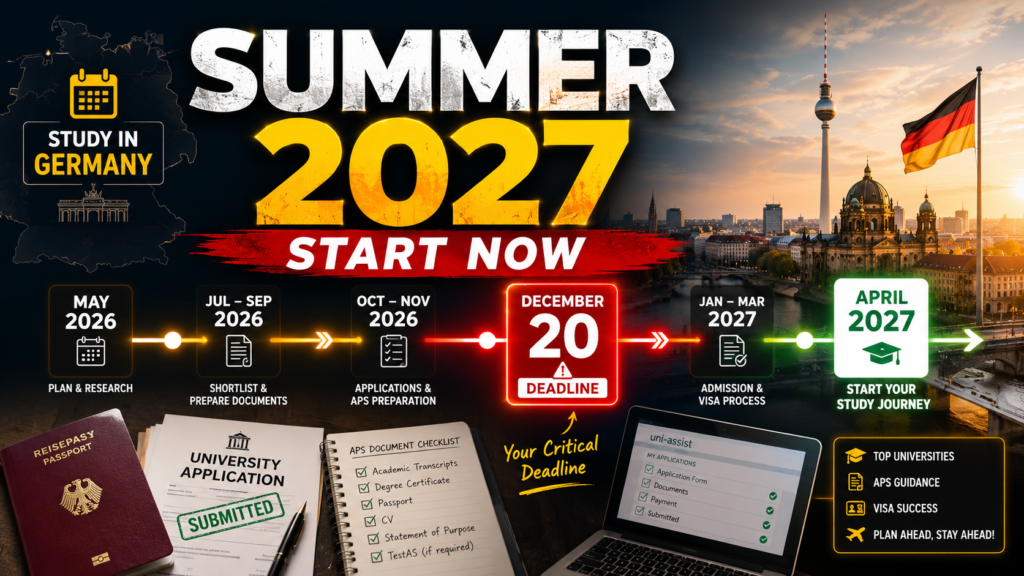
What Does the Month-by-Month Timeline Actually Look Like?
This is the section to screenshot and pin somewhere visible.
May to June 2026 — Base Documents and Eligibility
Gather your passport, school certificates, bachelor’s transcripts, degree certificate or provisional certificate, grading scale for grade conversion, and CV. Research your country’s equivalency check requirements — APS, NARIC, WES, or whichever body applies to you — and begin that process immediately. Plan your language exam dates.
July to August 2026 — Build Your University Shortlist
This is where most students waste the most time by doing it wrong. Build a shortlist of 25 to 40 programs in an Excel tracker. Confirm summer intake availability for each specific course, not just the university. Start your Statement of Purpose first draft. Request your Letters of Recommendation early — give your referees enough time. Use EtaInfi.com to shortlist 10 times faster, then verify every detail on the official university page.
September to October 2026 — Language Results and Course-Specific Documents
Have your IELTS, TestDaF, Goethe, or whichever certificate your courses require in hand by this point. Collect your Letters of Recommendation. Prepare your module handbook or syllabus for master’s applications. Set up your uni-assist account. Sort out any certified translations required. Complete your VPD application if your target universities need it.
November to December 2026 — Final Application Package
Your personal deadline is 20 December 2026. Not the official DAAD deadline of 15 January. DAAD itself recommends applying at least 8 weeks before the deadline — which means you should be submitting in December, not starting. By this point, your shortlist is locked, SOPs are reviewed and finalised, LORs are collected, portal accounts are created, application fees are paid, and documents are uploaded. Save screenshots of every submission.
January 2027 — Corrections and Backup Applications Only
This is not the month to start. Fix any errors you missed, submit emergency backup applications if needed. If you are just starting your main applications in January, you have already lost significant ground.
February to March 2027 — Results, Visa, and Preparation
Admission letters arrive. Book your visa appointment early. Open your blocked account and verify the required amount for 2027 — this figure updates each year. Arrange health insurance and begin your housing search. Lectures start around 12 April.
How Do You Build a University Shortlist That Actually Works?
Most students shortlist in their head or in a WhatsApp group thread. That approach falls apart the moment deadlines get close, because nothing is tracked, nothing is verified, and documents are missing at the worst possible moment.
Build a proper Excel tracker. The columns that matter: university name, city, state, type (Technical University, University of Applied Sciences, Hochschule), public or private, degree level, course name, subject cluster, language of instruction, summer intake confirmed for this specific course, application deadline, your personal deadline (always earlier), application portal type — Direct, uni-assist, VPD plus portal, or hochschulstart — tuition fee and semester contribution, language requirement with the exact band or level required, APS or equivalency requirement, credit requirement, competition level, your profile match assessment, risk level, current status, next action, and the source URL.
EtaInfi.com gives you speed in building this list. The official university page gives you truth. Deadlines change. Course availability changes. Language requirements change. One university may offer summer intake for one course inside a department but not for your specific course. Always verify on the source.
For folder organisation: keep one base documents folder, one folder per university, a submitted folder for completed applications, and a receipts folder for payment confirmations and submission screenshots.
Which Platforms Should You Actually Be Using?
EtaInfi.com is built specifically for international students shortlisting programs in Germany — it filters and organises programs in a way that saves significant time compared to manual searching.
Beyond that, Hochschulkompass is maintained and updated directly by the universities themselves, which makes it one of the most reliable course databases available. DAAD My GUIDE is the official program database and the authoritative source for program-level information. uni-assist is the document portal used by many universities for application processing. The official university website is always your final source of truth on deadlines, requirements, and course availability. The anabin database lets you check your country’s qualification status against German standards. Your country’s APS or equivalency body handles eligibility verification. And your German embassy or consulate website covers visa requirements.
One thing to avoid: articles titled “Top 20 Summer Intake Universities in Germany.” These lists go out of date quickly, may not apply to your country, and almost certainly don’t account for your specific course’s availability. Open the actual course page every time.
Competitive vs Realistic — How Do You Build a Smart, Balanced List?
A program tends to be more competitive when it is English-taught at a public university with no or low tuition, located in Munich, Berlin, Stuttgart, or Karlsruhe, in a high-demand field like Computer Science, AI, Data Science, Mechanical Engineering, Automotive, or Robotics, at a well-known Technical University like TUM, RWTH, KIT, TU Berlin, or TU Darmstadt, with no German language requirement.
Realistic doesn’t mean worse. It often means a smaller city, a University of Applied Sciences, German-taught or partially German-taught instruction, a more specific subject focus, and stronger alignment between what the program offers and what your profile shows.
A strategy most applicants miss: instead of only searching for “Data Science,” also search for Applied Computer Science, Business Informatics, Scientific Computing, Information Systems, Automation and Embedded Systems, Computational Engineering, Renewable Energy, or Production Engineering. Everyone runs toward the same course names. Searching like a strategist means finding strong programs with less crowding at the door.
Winter vs Summer — Which One Is Actually Better for You?
Winter intake offers more courses, more bachelor’s program options, more seats, more structure, and more scholarship cycles. It starts in September or October and is the better choice if your target course only runs in winter or if you’re applying at the bachelor’s level.
Summer intake offers a more focused pool of programs, starts in March or April, and can have less competition in specific courses. It works well when your documents are already ready, your target course is confirmed to offer a summer start, and you genuinely don’t want to wait a full year.
Neither intake is objectively better. The better one is whichever matches your readiness and your target course’s availability.
Where Should You Go from Here?
Here is the rule that holds across every step of this process: don’t start with the motivation letter. Start with the shortlist.
Find the course. Verify that summer intake is confirmed for your exact course. Check the exact portal and deadline. Prepare your documents backwards from that deadline. Track everything in your Excel file.
Germany doesn’t reward last-minute confusion. Every strong application you see come together by December started in May or June with someone who treated the process seriously from the beginning.
If you want the complete walkthrough — timelines, shortlisting strategy, real experience from someone who went through the German system and became a German citizen six years after starting the process — watch the full 14-minute guide on YouTube. It covers everything in this post with on-screen visuals, real examples, and answers to the questions that don’t make it into most written guides.
The ETAINFI team is here to help you build your shortlist, review your profile match, and make sure your 2027 journey starts the right way. Drop your questions in the comments on the video or reach out directly — good preparation is the one thing that separates a successful summer intake application from a missed one.
Auf Wiedersehen, and good luck for Summer 2027.