On paper, my Germany story looked perfect.
Master’s degree.
Manager title in three years.
Permanent Residency.
Even citizenship.
But behind the clean LinkedIn milestones, I carried a quiet, daily frustration I couldn’t name. I wasn’t failing. I was functioning. And that’s exactly why it took me five years to notice the real problem.
If you’d rather watch the full story instead of reading it, it’s here (and it’ll hit even harder in video): https://youtu.be/u54rIjYacN0
Why can you “succeed” in Germany and still feel stuck inside?
Here’s the benefit upfront: if you’ve achieved things in Germany but still feel oddly disconnected, you’re not imagining it—there’s usually one missing layer.
I was a manager who could present confidently in English, run projects, deliver outcomes, and handle pressure. But put me in a casual kitchen conversation at work—two colleagues switching to German mid-sentence—and my confidence dropped like someone cut the power.
That gap creates a strange double life: you look integrated on paper, but in real life you hover at the edge of conversations, jokes, networking, and those tiny moments that actually build belonging.
And that’s when it hit me: my “stuck” feeling wasn’t about paperwork or qualifications. It was something quieter. Something personal.
What is the invisible barrier nobody warns you about in Germany?
Here’s the value: once you see the barrier clearly, you can stop blaming your personality and start fixing the real thing.
The invisible barrier isn’t your résumé. It isn’t the visa process. It isn’t even “German people are cold” (that’s usually a lazy conclusion).
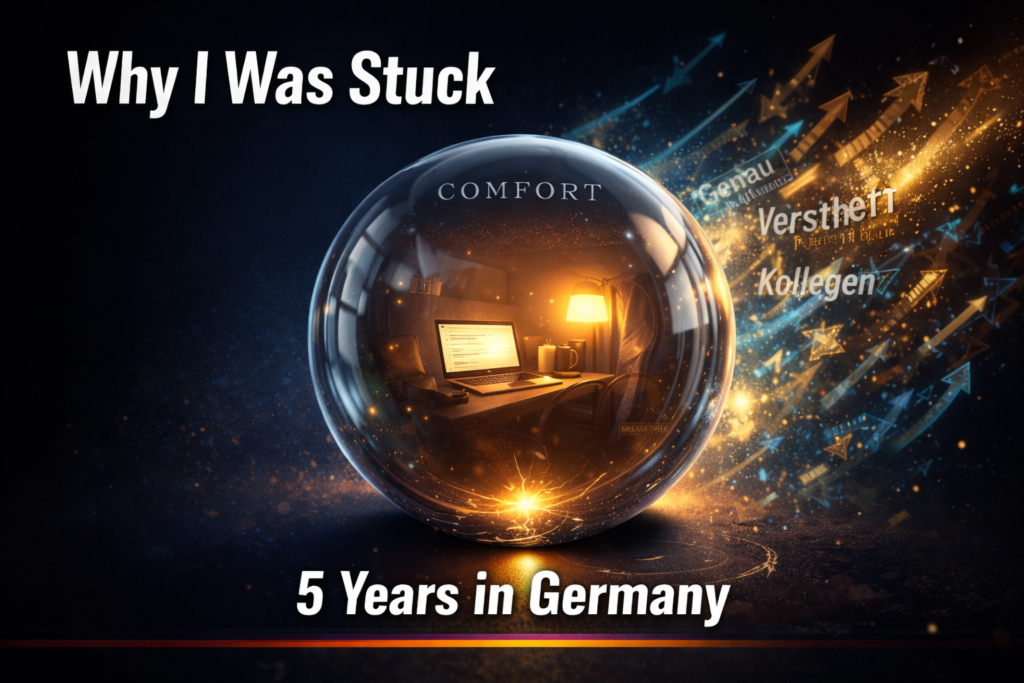
The real barrier is comfort.
Comfort looks harmless. It even looks responsible. A stable English-speaking environment. A routine you can manage. No awkward pauses. No risk of sounding “stupid.”
But comfort in a foreign country can become a soft cage. It keeps your life smooth—and your integration shallow.
Why doesn’t “studying German properly” automatically make you speak it?
Here’s the benefit: if you have grammar knowledge but freeze in real life, you don’t need more rules—you need a different learning process.
When I arrived in 2018, I did what most students do: courses, grammar tables, cases, articles—der, die, das drilled into my brain like formulas.
I treated German like a science subject:
- memorize the rules
- understand the structure
- speak when ready
But language doesn’t behave like math. You don’t “solve” German.
You live it.
You learn it when someone interrupts you gently with a better phrase. When you mispronounce something and still survive the moment. When your brain connects a word to a feeling, a laugh, a small embarrassment, a win.
That’s the part classrooms can’t fully give you.
How did one “survival decision” quietly cost me years?
Here’s the value: you can make practical decisions without sacrificing your long-term integration—if you recognize the trade-off early.
After graduating in 2020, the pandemic chaos hit. The German job market felt like a locked door with a thousand keys—none of them fitting.
I kept going anyway. I built a portfolio. I applied relentlessly—hundreds of applications—until I finally landed a role in early 2021.
It was a 100% English team.
And I told myself the sentence that sounds sensible and destroys years:
“I’ll improve my German later.”
Because I needed stability. I had an educational loan. I needed income. All real reasons.
But I didn’t realize what “later” does once you enter the English bubble:
life becomes easier… and the language stops being urgent.
And when your language stops being urgent, it stops growing.
Why does the “manager trap” freeze your German instead of improving it?
Here’s the benefit: if your German is stagnating even while your career grows, you can reverse it—fast—once you understand what’s happening.
I worked hard. I proved myself. I moved up. My salary improved. The title looked impressive.
But my German didn’t level up with me.
It froze. Then slowly, it started dying.
Because language doesn’t grow in theory.
It grows in the messy places:
- awkward small talk
- broken sentences
- the moment you search for a word and your face gets hot
- the quick correction you didn’t ask for but needed
And I avoided those moments—because I could.
That’s the trap: the more competent you become in English, the easier it becomes to protect yourself from German.
What if the real enemy isn’t grammar—but ego?
Here’s the value: once you stop protecting your ego, you stop wasting years.
My biggest problem wasn’t time.
It wasn’t intelligence.
It wasn’t even grammar.
It was ego.
I didn’t want to sound stupid.
I didn’t want colleagues correcting me.
I didn’t want to be the “beginner” again.
So I stayed safe and spoke English.
Easy, right?
But safety has a cost. It builds a ceiling above you—quietly. You don’t notice it until you’re five years in and still hesitating before simple conversations.
One painful truth changed everything for me:
If you’re not slightly uncomfortable in your target language, you’re not improving.
What changes when you choose total honesty at work?
Here’s the benefit: one sentence can turn your workplace into a language accelerator.
Recently, I joined a 100% German-speaking environment.
On day one, I said something I wish I’d said years earlier:
“Look, I can deliver results. But I need your help improving my German. Please correct me whenever I say something incorrect.”
That simple move did something powerful: it removed the fear.
Instead of hiding mistakes, I invited corrections. And suddenly, I started learning 10x faster German—not because I became smarter, but because emotion entered the process.
Language sticks when:
- you get corrected
- you laugh at yourself
- someone rephrases your sentence in a nicer, more natural way
- you feel the moment, not just memorize it
That’s when German moves from your head… into your body.
If you could restart in Germany, what practical strategy would make you fluent faster?
Here’s the value: these five moves reduce wasted years and speed up real integration—especially if you work in an English bubble right now.
1) How can you enter a German environment earlier—even if it’s not perfect?
Exposure beats comfort. Every time.
Even if the salary is lower. Even if the role isn’t your dream. Werkstudent roles and internships in German teams are pure gold because they force daily, low-stakes practice.
Full-time English roles feel safe—but they slow your integration.
2) Why should you stop chasing perfection and start chasing rhythm?
You don’t need perfect grammar to speak. You need flow.
If you’re waiting to “feel ready,” you’ll wait forever. Fluency gets built in broken conversations—the ones you survive and repeat until they become normal.
3) What if apps and streaks are measuring the wrong thing?
Word counts. streaks. minutes studied.
None of that matters if you don’t feel the language.
Your brain remembers emotion. The embarrassing mistake you made in a real conversation? Congratulations—you just learned that word for life.
4) How do you learn German through life instead of lessons?
Put German where your life already is:
- podcasts on walks
- supermarket announcements
- meetings and emails
- office jokes and casual chats
If German only exists in a “study block,” it stays trapped in that box. When it becomes part of your daily life, it starts growing naturally.
5) Why is dropping ego the fastest integration hack?
This is the hardest—and the most powerful.
You must allow yourself to sound like a beginner.
You must let people correct you.
You must survive awkward silence.
That discomfort?
That’s not failure. That’s integration into German culture.
What’s the bigger realization you only get after years in Germany?
Here’s the value: German isn’t just a career tool—it changes how you exist here.
Over time I realized learning German wasn’t only about job growth.
It was about identity.
When you operate in another language:
- you think differently
- you behave differently
- you see the room differently
In my case, I had the passport.
But I didn’t fully have the access.
Why did I start ETAINFI—and how can it help you avoid my mistakes?
Here’s the benefit: you don’t need to “learn the hard way” like I did—ETAINFI exists to shorten your learning curve.
What pushed me to start ETAINFI wasn’t just my personal regret. It was watching students and newcomers get looted by agencies—paying thousands for basic advice, or worse, getting misinformation that derails their plans.
I want to help people build a real path abroad with clarity—so they succeed, then help the next person without expecting anything in return.
That’s the community I’m building: honest, practical, no gatekeeping.
If you want the full story + the practical strategy in one place, watch it here: https://youtu.be/u54rIjYacN0
What should you tell yourself if you’re scared to speak German today?
If you’re nervous about speaking German at work or at university, I get it. I was that person.
But trust this:
Your broken sentences today are building your confidence tomorrow.
And five years from now?
You’ll thank yourself for starting earlier—imperfectly, loudly, and anyway.
If you want support as you do it, ETAINFI is here for you.
Tschüss.