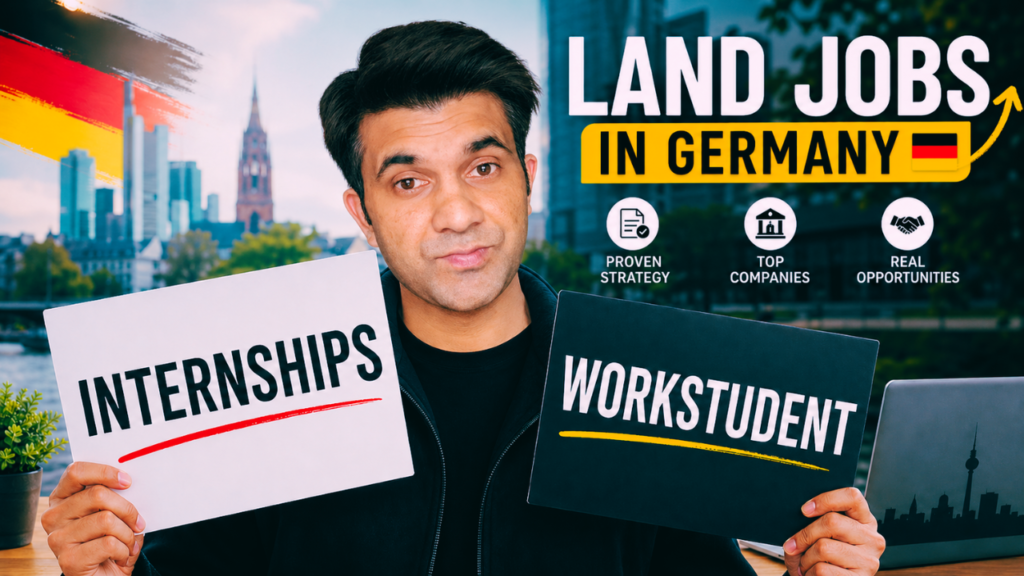
You sent 20 applications. Then 50. Then 100. Maybe more.
And what came back? Silence. Auto-rejections. “Unfortunately, we have decided to move forward with other candidates.” Or nothing at all.
After enough of that, most students stop blaming the process and start blaming themselves. Their accent. Their CV. Their university. Their German. Their luck. Their entire value as a candidate.
That is not a personal failure — that is what happens when you play a structured, paper-driven hiring game by the wrong rules. Germany is not rejecting most international students because they are useless. Germany is rejecting them because they are easy to reject.
And those are two very different problems. One cannot be solved. The other absolutely can.
Is Germany’s “Worker Shortage” Even Real If You Keep Getting Rejected?
Germany has a skilled-worker shortage. That is documented fact — the ifo Institut reports it year after year, and it is not going away. So why does it feel completely invisible when you are staring at a pile of rejection emails?
Because Germany can have a worker shortage and still reject you like you do not exist. Those two things can be true at the same time. That is the half-truth nobody properly explains to international students.
“Germany needs talent.” “Germany is desperate for skilled workers.” Fine. But desperate for workers does not mean desperate to hand internships and Werkstudent roles to international students who look complicated on paper.
Because companies are not just asking whether you are smart. They are asking: How easy are you to place? How easy are you to onboard? How easy are you to justify internally? How much paperwork comes with you? How long will you stay? Do you even understand how this process works?
Once you understand that those are the real questions, the rejection pattern starts to make sense — and more importantly, it becomes solvable.
Is Your GPA Actually Your Biggest Weapon Here?
Here is what most students believe going in: study hard, build your grades, and the market will eventually recognize your value. It is not wrong advice. It is just dangerously incomplete for the German student hiring context.
Your biggest problem is usually not your intelligence. Your biggest problem is that your application is weak in the exact places Germany uses to judge seriousness.
German hiring, especially at the student level, screens for something much colder than potential. It screens for fit, structure, proof, predictability, and low friction. So when your CV is loaded with words like “passionate,” “dynamic,” “leadership,” “team player,” and “fast learner” — you think you are building value. A lot of hiring teams read that and think one thing: noise.
They want specifics. What exact tools do you use? What exact modules did you complete? What exact tasks did you carry out? When exactly can you start? How many months can you commit? What exactly are you applying for? And where is the proof?
This is why so many students get buried — not because they are untalented, but because they show up with motivation while the market is screening for clarity.
And here is where it gets uncomfortable. If a company expects a cover letter, a CV, a transcript, an enrollment certificate, proof that the internship is mandatory, and confirmation of your work and residence status — and you apply like it is a casual one-click job platform — what are you actually communicating? You are communicating that you do not understand how serious their process is. Germany’s official application guidance makes clear that employers specify required documents upfront, and missing any of them is an immediate signal of low seriousness.
So stop asking “How do I stand out?” Ask instead: “How do I become the easiest serious candidate to move forward?” That question will change your results faster than another 100 blind applications.
Are You Stuck in the English-Only Trap?
Here is a story thousands of international students tell themselves: “Don’t worry. I’ll just focus on English-speaking internships.”
You might find some opportunities in English. That is not the same thing as having access to the market. And the difference matters more than most students realize until it is too late.
What actually happens is this: thousands of international students all pile into the same small English-only bubble. Berlin. Munich. Some startup roles. Some international corporate teams. The same obvious postings on the same obvious platforms in the same obvious cities. Then they get rejected there and conclude that the whole German market is dead.
The market is not dead. The strategy is just too small.
The part of Germany most students completely ignore is the part holding up the economy: the Mittelstand. Medium-sized companies. Niche industrial leaders. Family-run businesses that dominate their sectors quietly and consistently. These companies make up more than 99% of German firms, according to the Federal Ministry of Economic Affairs. They are often outside the flashy startup ecosystem. They are rarely trending on LinkedIn. And they are significantly less crowded with international applicants.
Your German is not some nice-to-have integration bonus. It is leverage. Major employers like Volkswagen still list German as the working language across most of their departments. The moment your language becomes genuinely functional in a work setting, you stop fighting only inside the crowded international bubble. The market opens wider.
The more you depend entirely on English-only roles, the smaller your options become — and the less bargaining power you have. Most students learn that lesson far too late.
Do You Know the Legal Difference That Can Completely Change Your Application?
This is the part almost nobody explains properly — and it is one of the few things that can materially change how attractive your application looks before you even get to the interview.
In Germany, there are two types of internships. A Pflichtpraktikum is a mandatory internship required under your specific study regulations. A freiwilliges Praktikum is a voluntary internship you pursue independently. This is not a boring technical detail. It is a legal reality that affects your attractiveness as a candidate — especially if you are a student from a non-EU country.
For third-country students, voluntary internships generally count toward the annual 140 full-day (or 280 half-day) work quota. Mandatory internships, in most cases, do not. That distinction removes a real legal concern for employers considering your application.
But most students are not using this strategically. They go to a company and essentially say: “I need a two-month mandatory internship to complete my degree requirements.” From the student’s side, that sounds reasonable. From the company’s side, it often sounds like: “Please spend time onboarding and training me, and I will leave the moment I become useful.”
That is the mistake. You are presenting yourself as a short-term burden.
The stronger play is to pitch continuity. Say instead: “I can begin with my mandatory internship phase, and if the fit is right, continue immediately in a follow-on Werkstudent arrangement under a separate contract.” That single shift changes the psychology completely. Now you are not offering a disappearing intern. You are offering a lower-friction entry point with a clear path to longer-term value. Even major employers like BMW explicitly state that combinations of mandatory and voluntary internship phases under separate contracts are possible.
Stop presenting yourself like a temporary headache. Start presenting yourself like a smart, low-risk sequence. That is not begging. That is positioning.
What Does It Take to Stop Being Easy to Reject?
Let’s end the self-deception.
You do not have a motivation problem. You do not have a raw ability problem. And for most of you, the German market was never the problem either. You have a strategy problem. And strategy can be fixed.
You were told to just apply more. Wrong. You were told English is enough. For most international students, wrong. You were told good grades would save you. Wrong. You were told the market would eventually see your potential. Wrong again.
Germany does not reward hope. Germany rewards signal. And signal — the clean, structured, low-friction presentation of exactly what you offer, when you are available, and why you are a manageable hire — is a skill. Not a passport, not a personality trait, not a lucky break. A skill that can be learned, built, and improved in weeks.
The students who turn their search around are not the ones who sent 200 applications instead of 100. They are the ones who stopped and asked a smarter question: How do I become the easiest serious candidate to move forward? Then they rebuilt their approach around that answer — the right CV structure, the complete application package, the correct framing for their internship pitch, and the language that stops them from sounding like anonymous portal traffic.
That is what ETAINFI’s Germany Internship & Werkstudent Kit is built to give you: the German-style CV structure, the application checklist most students skip, the follow-on internship positioning template, and the exact outreach language that makes hiring teams take you seriously. No fake inspiration. No empty “believe in yourself.” Just a smarter way to play a game most international students were never properly taught.
The market is not getting easier. But you can absolutely get harder to reject.
Visit etainfi.com to get started.