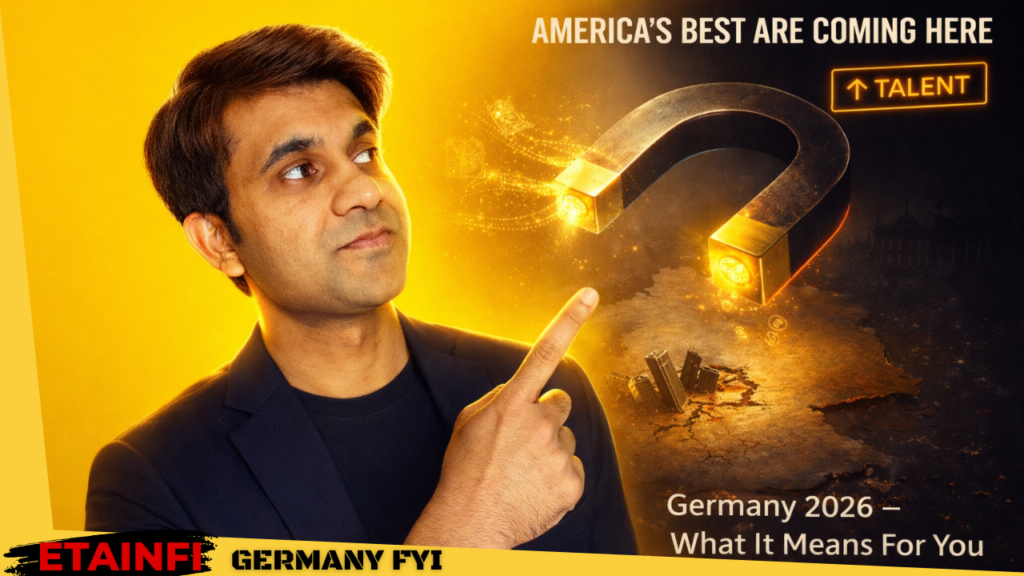
Germany is shifting faster than most international students realize.
Elite American researchers are moving into German labs. Bavaria is quietly building a new tuition wall. Volkswagen’s graduate pipeline is losing the stability it once promised. And one common CV mistake is getting applicants filtered out before a recruiter even reads the first line.
These are not isolated headlines. Together, they reveal where Germany is opening up, where it is becoming more expensive, and where students need to move smarter in 2026.
Prefer to watch instead of read?
You can watch the full video here: Germany 2026 weekly update
Here is what these changes mean for your study and career strategy in Germany.
Why are elite American researchers moving into German labs, and what does that mean for students?
The biggest opportunity in this story is access to stronger research ecosystems without paying elite-university prices.
When high-level American researchers move to German universities, they bring more than impressive job titles. They bring research networks, funding experience, international collaborations, and years of academic credibility built inside one of the world’s most competitive systems. That changes the value of the classroom, the lab, and the faculty around you.
For students, this matters immediately.
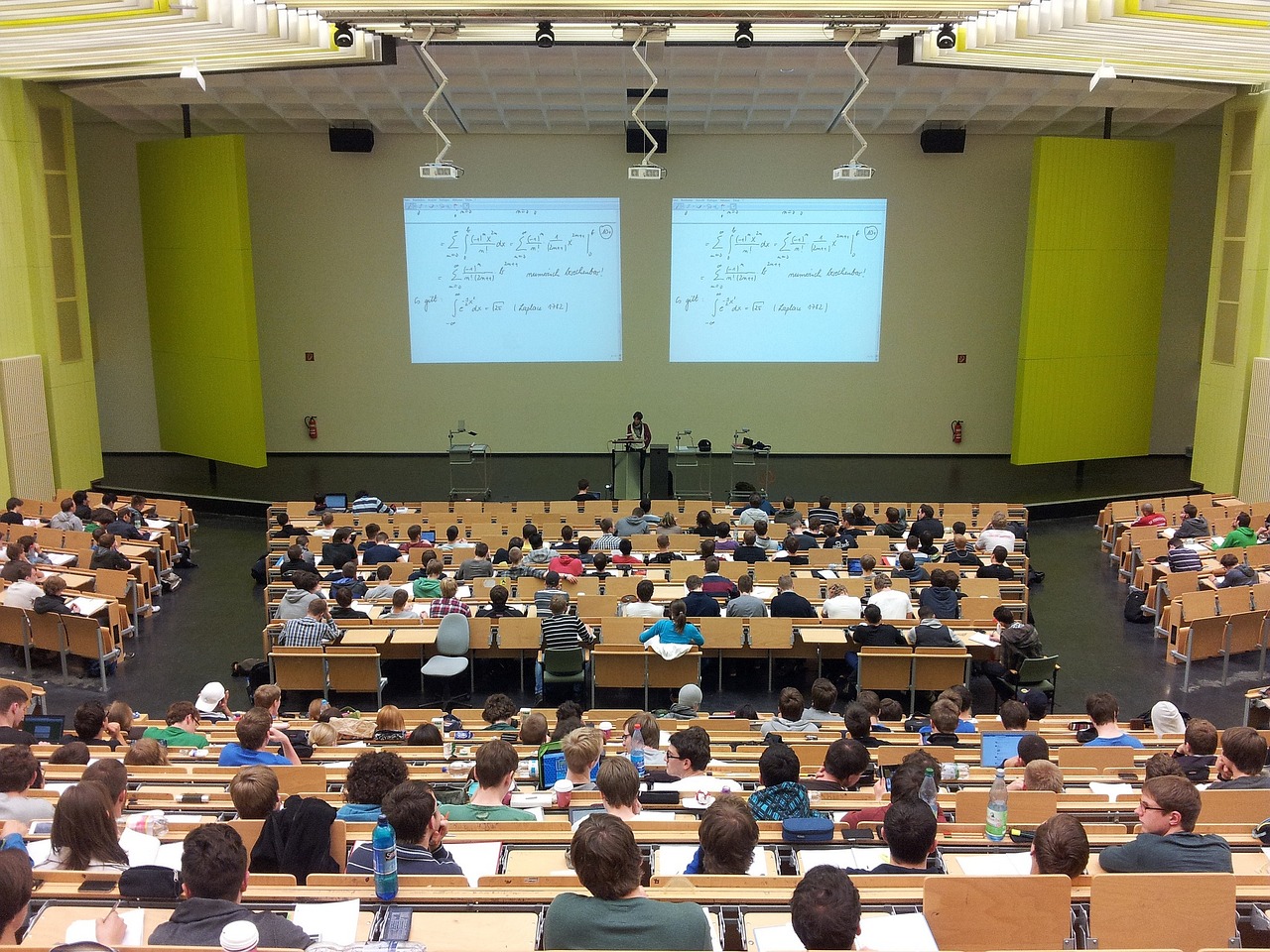
The professors entering German lecture halls today may have direct links to top international institutions, research groups, and future career opportunities. That means your degree is no longer just about attending classes and collecting credits. It is also about proximity to people who can open doors beyond Germany.
Most students miss this. They sit quietly in the back row, attend lectures, and go home. Meanwhile, the real opportunity is often a few steps closer: office hours, research assistant roles, faculty-led projects, and early academic connections that can lead to internships or international collaborations.
Germany is giving many students access to a globally competitive research environment at a fraction of the cost. But that advantage only works if you step into it. Find out which professors have international backgrounds. Show up early. Ask better questions. Get involved before everyone else realizes what is changing around them.
Is Bavaria building a tuition wall for international students, and how fast is it spreading?
The key takeaway is simple: Germany is still affordable in many places, but that window may not stay open forever.
Bavaria has already started sending a clear message. TUM moved first. Now the University of Erlangen-Nuremberg is preparing to follow. What used to sound like a possibility is beginning to look like a policy direction. The tuition wall for international students is no longer theoretical. It is taking shape in real time.
That makes timing more important than ever.
Many applicants still assume that public universities across Germany will remain low-cost by default. That assumption is becoming riskier, especially in states where policymakers are more open to charging international students higher fees.
At the same time, the picture is not all negative. The new 2026 ranking of Germany’s top twenty universities shows that most of those institutions still charge little to nothing in tuition. That means there is still room to make smart choices, but only if you act with current information rather than old assumptions.
This is where careful planning matters. Students who move now can still target strong universities before fee structures spread further. Students who wait may find that the same degree suddenly comes with a much heavier financial burden.
Affordability in Germany is no longer something to assume. It is something to verify.
Is Volkswagen still the dream, or is Germany’s real opportunity moving elsewhere?
The real benefit of understanding this shift is that it can save you from building your career around an outdated target.
For years, many students in Germany saw companies like Volkswagen as the ideal landing point after graduation. Big brand. Strong structure. Safe future. That image carried weight for a long time.
Now it is losing its grip.
Volkswagen’s profits dropped sharply in 2025. Porsche also faced major pressure. Job cuts are being publicly discussed, not quietly denied. The old idea that a giant automotive name automatically equals stability is becoming harder to defend.
But the deeper story is even more revealing.
A growing share of the German workforce is described as “innerlich gekündigt” — mentally checked out while still physically present. That kind of disengagement matters because it changes how companies function from the inside. When large firms slow down, stop hiring, and lose internal energy at the same time, they become less attractive for young professionals who want momentum, learning, and upward movement.
That creates space elsewhere.
Germany’s Mittelstand, the mid-sized hidden champions that power much of the economy, are under real pressure to attract people who are skilled, adaptable, and ready to contribute. These companies may not always offer the same global brand recognition, but many offer something more valuable right now: real demand.
That is why graduates need to rethink where they send their applications. Do not build your entire job strategy around struggling giants. Start paying attention to the companies that are actually hiring, competing for talent, and rewarding practical skills.
The prestige path is not always the opportunity path.
What is the CV mistake getting applicants rejected before a recruiter even blinks?
The biggest advantage of fixing this is immediate: your CV becomes readable, believable, and far more likely to survive the first filter.
Too many applicants are still submitting generic, static CVs that say almost nothing about how they actually work. The language looks polished on the surface, but the document feels empty underneath. Recruiters see vague objective statements, tired buzzwords, and broad claims about motivation or flexibility with no real proof attached.
That is exactly what gets ignored.
Today, your Lebenslauf often passes through automated filters before it reaches a real person. And when it does reach a recruiter, you are already competing against time, attention, and dozens of similar profiles. A generic CV disappears quickly because it gives no concrete reason to remember you.
The solution is not dramatic, but it does require sharper thinking.
Cut the vague language. Replace broad claims with specific examples. Show how you work, which tools you use, and what you have actually built, improved, analyzed, solved, or supported. If you use AI in your workflow, say how. If you worked with modern tools, research methods, automation, data, design systems, or technical platforms, make that visible.
Recruiters are not looking for adjectives. They are looking for evidence.
A strong CV does not just say you are adaptable. It proves it. It shows what changed, what you learned, and what result followed. That is what gets you through both automated systems and human screening.
So what should your next move in Germany be?
You do not need to panic. You need to position yourself earlier and more intelligently than everyone else.
The arrival of American researchers in German labs is a signal to engage more actively with your academic environment. The tuition wall in Bavaria is a reason to research universities with more urgency. Volkswagen’s decline is a warning not to anchor your future to an outdated graduate dream. And the CV mistake is a reminder that employers are rewarding proof, not polished generalities.
Germany still offers real opportunity in 2026. But it is becoming a market that rewards students who pay attention, move early, and make informed choices.
That is exactly where ETAINFI can support you.
If you want help choosing the right university, understanding job-market shifts, or building a CV that actually gets noticed, stay connected with ETAINFI. We break down complex changes into practical guidance you can use. Learn the system, make smarter decisions, and move forward with clarity.