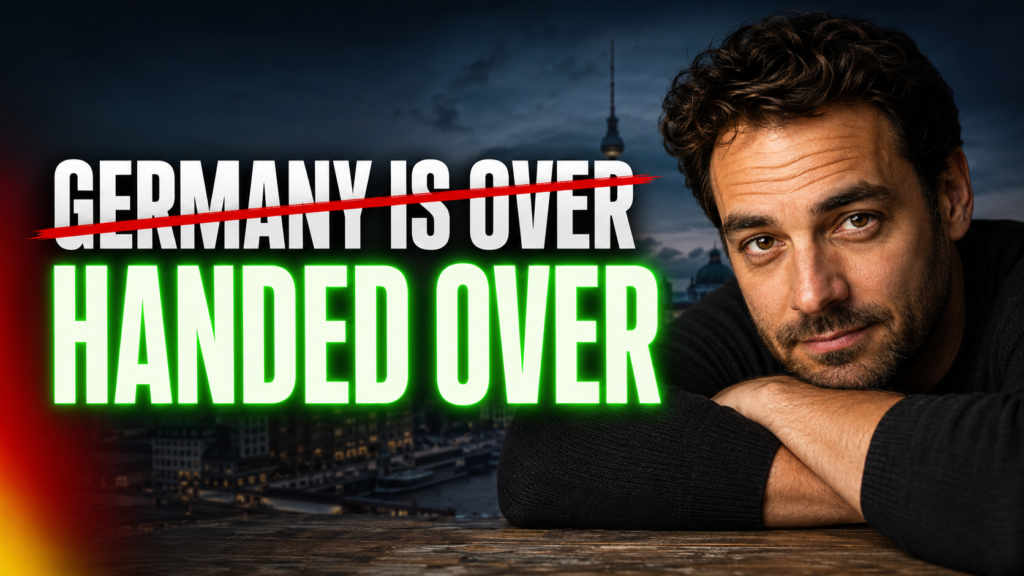
Germany’s Collaps is Best Thing Happened to Internationals Career.
May 25, 2026EtaInfi
Spend ten minutes in the comments under any video about Germany and you’ll come away convinced the place is on fire. “Don’t come, there’s nothing here anymore.” “We’ll be a second-world country in fifty years.” “Germany is a dying star — bright on the surface, burning out at the core.” One twenty-three-year-old says he’s decided not to bring a child into a future this bleak.
I read those words and I understand the anger behind them. I also notice something almost nobody points out: it’s Germans talking to Germans, about a Germany they feel trapped inside.
I’m not German. I landed here with a folder of documents, a stomach full of nerves, and a plan that fell apart in the first month. I missed appointments. I lost arguments with the language. I opened rejection emails I couldn’t even read yet. And I built a life here anyway.
So if you’re an international student, a young professional, or someone abroad wondering whether it’s even worth coming anymore, let me tell you what the people inside that comment section can’t. Germany is not over. It’s being handed over. And the very crisis making young Germans furious is the reason a door is open for someone like you.
Prefer to read? Keep going — everything from the video is below.
Is Germany Really Finished — Or Are You Reading the Wrong Story?
The doomsayers aren’t lying to you. They’re just reading one chapter and calling it the whole book.
Here’s the part that matters: there’s a wide gap between “Germany has serious problems” and “Germany has no future,” and almost everyone collapses the two into one. A country with no future doesn’t keep advertising for nurses, engineers, and teachers. A country in the middle of a generational handover does exactly that.
That single distinction reframes everything that follows. Before you decide whether to pack a bag, it’s worth knowing which story you’re actually walking into.
What Do the Pessimists Actually Get Right?
Plenty — and pretending otherwise would insult your intelligence.
I’m not here to sell you a glossy version of this country. Germany has real problems, and if you arrive expecting everything to glide, it will humble you fast. The pension system is straining. Housing is brutal. People grind through forty-hour weeks and quietly ask what it’s all for. By 2035, roughly one in four people living in Germany will be sixty-seven or older — that figure comes from Destatis, the federal statistics office, not from a stranger’s opinion. Growth has been sluggish, with the European Commission projecting only around 1.2% GDP growth for 2026 and 2027.
So when someone tells you Germany is finished, I get the emotion. But emotion isn’t the full map. Serious problems and no future are not the same sentence.
Why Does a “Dying” Country Still Beg for Skilled Workers?
Because it isn’t dying. It’s short-staffed for its own future, and that shortage is your leverage.
The Federal Employment Agency lists shortages across 163 occupations — nearly one in eight skilled jobs is affected. Sit with that, then ask the obvious questions. Why does a “finished” country still need nurses, engineers, IT specialists, teachers, doctors, technicians, and researchers just to keep the lights on? Why did it lower the Blue Card salary threshold for recent graduates? Why is the DAAD expecting around 420,000 international students this winter semester? Why pour €500 billion into infrastructure and climate through 2036?
None of that reads like a country closing the book. It reads like a country being forced to write the next chapter — and that chapter won’t be written by people born here alone.
What Does a “Seat at the Table” Actually Buy You?
Not comfort. Something far more durable: a way in.
Germany doesn’t promise that life will be easy, smooth, and free of rejection. It promises that to no one — German or otherwise. What it offers instead is a seat at the table. Study, work, learn the language, pay your taxes, integrate, and slowly you stop being a visitor and start becoming part of the place. Recognised qualifications. Real healthcare. Worker protections. The rule of law. Long-term residence. And eventually, the thing certificates can’t print for you — belonging.
It doesn’t arrive overnight. It arrives step by step. And here’s the underrated mechanic in all this: when young Germans leave for Canada, Japan, or the United States — and many do — seats open behind them. Jobs. Apartments. Whole professions. The handover isn’t a metaphor. It’s vacant chairs, and somebody gets to sit down.
Why Do You Send 100 Applications and Hear Nothing Back?
Because you’re playing in the only part of the market everyone can see — and that part is broken.
The frustration is legitimate, so let’s not wave it away. Ghost jobs are real. So is internal hiring and “talent pool” posting that exists mostly to harvest profiles. Greenhouse, a major hiring platform, reported that in some quarters around 18 to 22% of its listings qualified as ghost jobs. But a fake posting doesn’t prove Germany has no opportunity. It proves the old way of job hunting has stopped working.
The German job market actually runs on four layers. The visible market — LinkedIn, StepStone, Indeed — is where everyone fights, and it’s the loudest and least forgiving. The internal market runs on referrals, former interns, thesis students, and Werkstudent connections. The pipeline market is companies quietly collecting profiles before a budget is even approved. And the trust market is the quietest of all: someone has already seen your work and decided you’re reliable.
Most international students throw their entire energy at the visible layer, hear nothing, and conclude that Germany rejected them. But often Germany didn’t reject your talent. It rejected the uncertainty around you. German hiring is cautious by design, and a recruiter is silently asking: Can this person communicate? Will they stay? Can they handle our documents and our clients? Or will they vanish in six months?
There’s a fair counterpoint here, and it’s partly true — some of this is a wage problem, not a worker shortage. Germany isn’t paying enough to lure young Germans into care work, the trades, or rural healthcare. But a salary that looks unconvincing to someone born here can look completely different to someone arriving from a country with thinner contracts, weaker pensions, and shakier healthcare. The same number means two different things depending on where you started.
So the real game was never firing off two hundred applications. It’s converting yourself from an unknown name into a trusted candidate — and the student route remains the cleanest path to do that. Third-country graduates can get up to 18 months after finishing their degree to look for qualified work, and they’re allowed to work during that window if they meet the conditions. That’s not a guarantee handed to you on arrival. It’s a runway. Use it to build proof.
Could Germany’s Most Boring Problems Be Your Biggest Career Move?
Yes — and that’s where the smart money quietly goes.
Almost everyone chases the glamorous version: the Berlin startup, the English-only role, big tech, six figures from day one. Meanwhile Germany’s deepest opportunities sit inside its most unglamorous problems. Hospitals running on paper that desperately need digital systems. Public offices crying out for automation. Factories that need someone who understands their data. Railways waiting to be modernised, energy systems short on engineers, small firms that need their processes fixed, schools short on teachers, wards short on staff.
Boring problems build stable careers, and Germany has a generous supply of them. That’s not an insult to the country — it’s an opportunity map. Stop asking where the shiny jobs are and start asking where Germany is under pressure and where you could make yourself useful. The whole country reshapes itself the moment you do.
What About the AfD, Racism, and the Fear You’re Carrying?
It’s a real concern, so I won’t dress it up as nothing.
Discrimination exists here, and some people will run into it. In May 2025, Germany’s domestic intelligence agency classified the AfD as a right-wing extremist party, though that classification was later put on hold during legal proceedings. The point isn’t to relitigate party politics — it’s that the country’s institutions aren’t asleep at the wheel. And alongside all of it, Germany is also millions of people who work with immigrants, study beside them, hire them, treat them as patients, marry them, and build ordinary lives together.
So stay clear-eyed. Be aware. Just don’t let fear become your entire map of the place. Germany is conflict and structure, frustration and safety, delay and possibility, all at once. Your experience will turn on where you live, what you study, the circle you build, and how deeply you actually enter the system.
So Should You Come — Or Stay Home?
Come if you’re built for the long game.
Come if you can sit with some loneliness at the start, if you’re ready to build proof instead of merely collecting certificates, and if you can accept that your first job probably won’t be your dream job. Come if you understand that Germany may not applaud you on day one but can come to respect you slowly — and that slow respect, once earned, is powerful.
Don’t come blindly if you want instant comfort, because Germany will frustrate you. Don’t come if you think “the country needs workers” means companies will beg for you, because they won’t. And don’t come if you believe one admission letter equals a settled future, because that’s not readiness — that’s a fantasy. I say this not to discourage you but because I’d hate for you to arrive carrying a daydream and feel broken the moment reality lands. Germany is still worth it for a lot of people. Just not for the fantasy version of you — for the version willing to get stronger.
What Five Questions Should You Answer Before You Book the Flight?
Under every big video about Germany, the same comment surfaces: where are the solutions? I can’t repair the pension system. But I can hand you a framework for deciding whether to come and how to come well. Sit down and answer these honestly.
First, which specific German problem does my field actually connect to? Second, what proof can I build before Germany trusts me — a real project, a thesis tied to a company, a Werkstudent role, a portfolio? Third, which layer of the market am I entering: only the visible job boards, or also professors, alumni, events, and internships? Fourth, what’s my plan for the twenty-four months after arrival, not just my first semester? And fifth, the one that decides everything: am I coming to escape something, or to build something?
Germany is punishing for people who only want escape. It’s quietly powerful for people who want to build.
The Honest Bottom Line
Germany isn’t easy, and anyone who tells you otherwise is selling something. But for the right person, at the right moment, with the right mindset, it is still entirely buildable — a place where an outsider with documents, nerves, and a broken first plan can put down roots that hold.
That’s where having someone in your corner changes the math. At ETAINFI, we help international students and professionals stop wrestling alone with the visible market and start moving through Germany’s real one — mapping your field to where the country actually needs you, building the proof that turns you from an unknown name into a trusted candidate, and walking you through the admissions, visa, and job-search steps that trip most people up. If you’re ready to build something here rather than just escape something there, reach out to ETAINFI and let’s plan your runway together.