Most students planning for Germany think they are safe as long as they apply before 15th July 2026. That feels like the finish line. It looks official. It sounds reassuring.
But for many applicants, that date is already too late.
Every year, students spend months researching, comparing universities, saving links, and watching videos, only to realize they misunderstood the timeline. By the time they are ready to submit, some programmes are already closed, Uni-Assist processing is still pending, and the intake they planned for quietly slips away.
That is the painful part. Most of them were not rejected. They simply ran out of runway.
If you are applying to Germany for Winter 2026, this is the shift that matters most: stop treating the deadline as the day you submit, and start treating it as the day everything should already be done.
Why Is 15th July 2026 Not Your Real Deadline?
The biggest benefit of understanding the real timeline is simple: you stop planning late and start moving early.
Here is what many students miss. If your programme uses Uni-Assist, which many international programmes do, the application process has a built-in delay. Uni-Assist itself advises applicants to allow at least 8 weeks for processing. Evaluation alone can take 4 to 6 weeks.
That changes everything.
When you count backward from 15th July, your working deadline is no longer mid July. In many cases, it lands somewhere around early May. And even that is the optimistic version.
This is where students get trapped. They think they still have time, so they stay in research mode. They keep opening tabs, comparing options, and telling themselves they will finalize everything next week. Meanwhile, the real clock is moving faster than they realize.
Are All German Programmes Really Open Until July?
The value of checking actual programme deadlines is huge: it tells you what is still possible right now.
Not every programme waits until July. In fact, many do not.
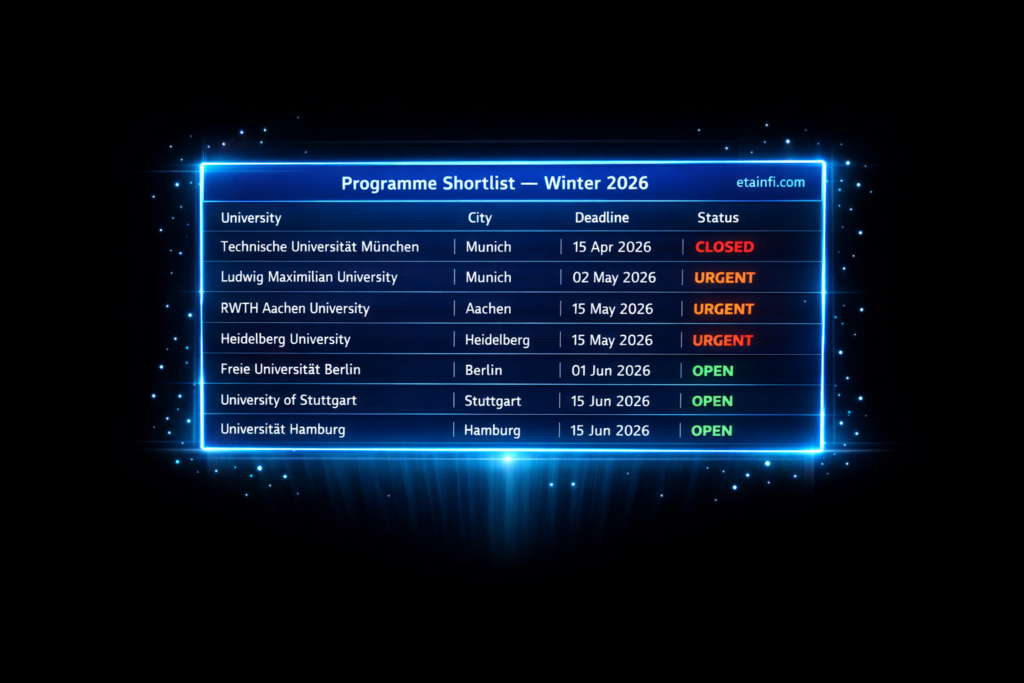
Some deadlines fall in March. Some close in May. A few strong programmes for Winter 2026 may already be closed. So the better question is not, Do I still have time? The real question is, Which of your programmes are still open right now?
That question forces clarity.
If you cannot answer it instantly, then you are not behind because you are unqualified. You are behind because your information is scattered. A rough shortlist in your browser history is not a strategy. It is just a pile of intentions.
What Does the “Research Stage” Actually Look Like for Most Students?
The benefit of recognizing this stage is that you can catch yourself before months disappear into unstructured browsing.
You probably know the feeling. Your laptop is full of tabs. You have searched for “best universities in Germany.” You may even have a rough list of programmes saved somewhere.
But there is no real system.
No deadlines tracked. No clear separation between Uni-Assist and direct university applications. No central place where your subject, city, language, application type, duration, requirements, and closing dates all sit together in a form you can actually act on.
That is the turning point.
Students who make it to Germany usually do one thing differently. They stop browsing and start executing. They move from collecting information to building a process.
How Can You Turn 22,000+ Programmes Into Your Options?
The biggest advantage of a good shortlist system is speed: you stop drowning in choices and start focusing on the programmes that fit you.
This is exactly where EtaInfi becomes useful.
On www.etainfi.com, you can filter Germany’s programmes by subject, city, language, and application type. That matters more than people think. Instead of staring at 22,000+ options, you narrow the field to something practical. Not random options. Your options.
That shift is powerful. It saves time, reduces confusion, and gives you a shortlist you can actually work with.
And the real strength is not just finding programmes. It is what happens next.
Why Does an Excel Shortlist Change Everything?
The core benefit is control: an Excel shortlist turns scattered information into a working application plan.
Once you download your shortlist as an Excel file, your process becomes tangible. You are no longer trying to remember deadlines from memory or reopen ten different university pages just to check basic details.
Now everything is in one place:
- Degree name
- University
- Location
- Duration
- Deadlines
- Requirements
That matters more than it seems. When all the important details live in one file, your brain is free to think strategically instead of acting as a filing cabinet.
For the next three months, that Excel file can become the central document around which your Germany application moves. It becomes the place where decisions happen, priorities become visible, and action becomes easier.
Why Do So Many Students Miss Germany Without Being Rejected?
The value of understanding this is clarity: you stop blaming luck and start fixing the real problem.
Many students who do not make it to Germany were not rejected at all. They simply lost time.
They spent March and April researching. They kept refining their ideas, saving more programmes, watching more content, and waiting to feel ready. Then they submitted in late June to programmes that had already closed in May.
That is not bad luck. That is poor sequencing.
Germany often rewards the prepared applicant more than the most qualified one. Preparation creates momentum. It protects you from deadline shock, document delays, and last minute confusion.
What Should You Do This Week If You Are Serious About Germany?
The biggest benefit of a weekly action plan is momentum: you replace anxiety with concrete next steps.
Here is what this week should look like if you are serious:
Start by going to www.etainfi.com. Build your shortlist and aim for 15 to 30 programmes. Then download the Excel file.
Your first move is simple. Sort by deadline.
Anything closing before June should move to the top. Those programmes need attention first.
Then split your list into two groups:
- Uni-Assist applications
- Direct university applications
That separation matters because the timing is different. The Uni-Assist ones should start now, not next week, not after more browsing, now.
At the same time, clean your documents in parallel. Do not wait until you have “finished choosing.” The strongest applicants move both tracks together. They shortlist and prepare documents at the same time.
That is how you create runway.
Where Can You Learn How to Use Uni-Assist and the Excel Properly?
The benefit here is confidence: you do not have to figure every step out alone.
If you need a full walkthrough on how to navigate Uni-Assist, how to use the Excel shortlist properly, and what documents to prepare, EtaInfi has already created videos to guide you through the process.
You can watch the full video here: https://youtu.be/RnNhxOozKcU
That is the best next step after downloading your shortlist. Once you can see your options clearly, the walkthrough helps you move from planning to execution.
What Is the Real Difference Between Students Who Make It and Students Who Miss Out?
The biggest takeaway is simple: Germany does not reward passive interest, it rewards preparation.
You do not need perfect certainty before you begin. You do not need to know every answer before you make your first move. But you do need a system.
That system starts with knowing your real timeline, identifying which programmes are still open, building a shortlist that matches your profile, and organizing everything in one place so deadlines stop slipping through the cracks.
If you are serious about studying in Germany, do not wait for confidence to arrive first. Start with structure. Clarity comes faster when you are already moving.
And if you want support, guidance, and practical tools that actually make the process easier, start with EtaInfi and watch the full walkthrough on YouTube: https://youtu.be/RnNhxOozKcU
Your Germany journey does not need more tabs open. It needs a plan.