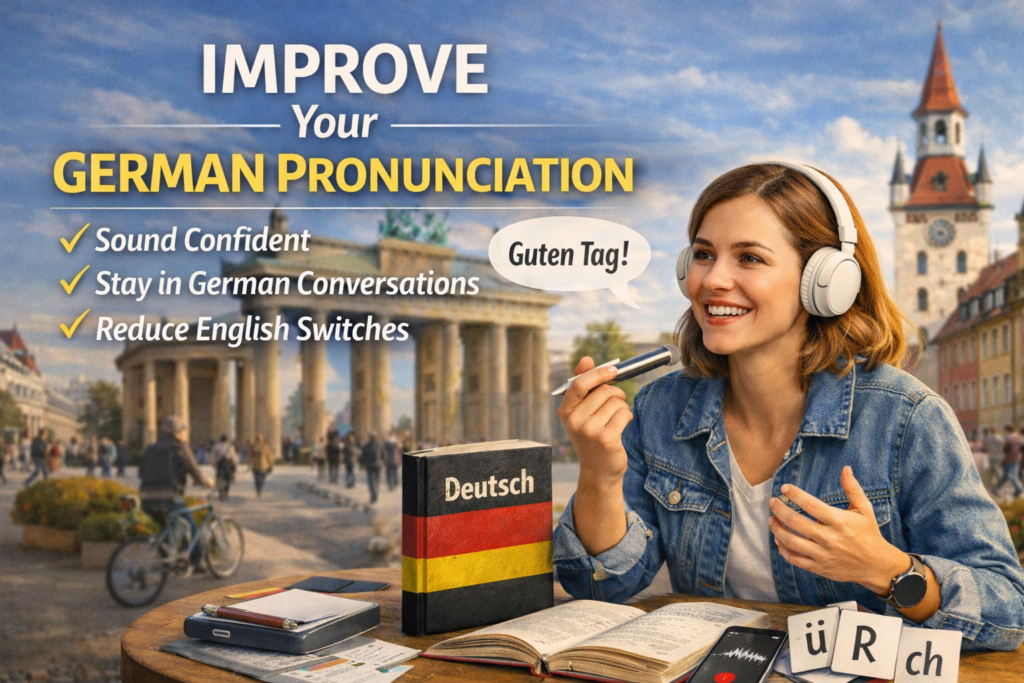
You can study German for months.
You can understand YouTube videos.
You can even pass exams.
Yet the moment you speak, something feels off.
People hesitate.
They lean in.
Then they switch to English.
This is not a grammar problem.
It’s a pronunciation problem — and the good news is that pronunciation is a skill you can train.
Why Does Pronunciation Matter More Than Grammar?
Core benefit: You stay in German conversations instead of being pushed into English.
Many learners are surprised by this, but listeners often judge your German more by how it sounds than by how correct it is.
You can make grammar mistakes and still be understood.
But unclear pronunciation forces listeners to work harder — and they often “solve” that by switching languages.
Strong pronunciation helps you:
- get understood immediately
- sound more confident and credible
- practice German more often
- enjoy speaking instead of avoiding it
Once people stop switching to English, your progress accelerates naturally.
How Can You Build Pronunciation Awareness?
Core benefit: You can only fix what you can feel and notice.
Most pronunciation mistakes are unconscious. Your mouth is following habits from your native language — and you don’t even realize it.
Start by building physical awareness:
- Where is your tongue?
- Are your lips tense or relaxed?
- Is the sound produced in the front or back of the mouth?
Simple daily warm-ups help:
- Slowly trace your tongue along your teeth (outside → inside → bottom)
- Gently circle your lips in both directions
- Relax your jaw before speaking
This is not optional. It’s like warming up before exercise — your mouth needs flexibility and control.
Want a Clear Roadmap from Beginner to Confident Speaker?
If you’re struggling to structure your learning or feel stuck at an intermediate level, this video explains a realistic path to strong spoken German — without expensive classes.
Are You Listening Actively or Just Hearing German in the Background?
Core benefit: You can’t pronounce sounds you haven’t fully absorbed.
Listening alone is not enough — it must be intentional.
Effective pronunciation listening means paying attention to:
- vowel clarity
- rhythm and stress
- sentence melody and intonation
One major shift most learners miss:
German vowels are often pure and stable, not sliding or changing shape.
Instead of only asking “What does this mean?”, start asking:
“How is the mouth moving to produce this sound?”
Need Tools That Actually Help With Pronunciation?
If you want apps, YouTube channels, and practical hacks that support pronunciation, listening, and speaking practice, this resource is a strong starting point.
https://www.youtube.com/watch?v=JpFzh4VGiGg
Why Does Repeating Out Loud Improve Pronunciation Faster?
Core benefit: Repetition turns sound into muscle memory.
Pronunciation is physical. Your mouth must learn new movements.
A powerful routine:
- Listen to a short German sentence
- Pause
- Repeat it exactly (speed, rhythm, melody)
- Record yourself
- Compare and adjust
Even 5–10 minutes, done consistently, makes a visible difference.
Which Sounds Should You Train First?
Core benefit: Targeted practice gives faster results than random speaking.
Most learners struggle with a small set of sounds that instantly reveal their accent.
Use a progression:
- Hear the difference
- Locate it in the mouth
- Produce it alone
- Combine it with other sounds
- Practice in words
- Use it in sentences
- Stress-test it in real conversations
Tongue twisters are effective because they force precision under speed.
How Do You Stay Motivated When Progress Feels Slow?
Core benefit: The right mindset keeps you practicing long enough to succeed.
Pronunciation progress is not linear. Often nothing seems to change — until suddenly it does.
Helpful mindset shifts:
- progress takes months, not weeks
- consistency beats intensity
- stress worsens pronunciation
- relaxed speech sounds clearer
A sustainable routine:
- 10 minutes, 3 times per week
- focus on one sound or pattern
- record weekly, not daily
- accept pauses and plateaus
What’s the Real Goal With German Pronunciation?
Perfect pronunciation is not the goal.
Clear, confident, understandable German is.
When your pronunciation improves:
- people stop switching to English
- conversations feel natural
- confidence replaces hesitation
- your German finally becomes usable
Learn German Smarter With ETAINFI
If you’re planning to study, work, or settle in Germany, German is not optional — it’s leverage.
ETAINFI focuses on providing clear structure, realistic strategies, and practical learning videos guides so you don’t waste time on methods that feel productive but don’t move you forward.
Start with the videos above, apply the principles, and build from there.