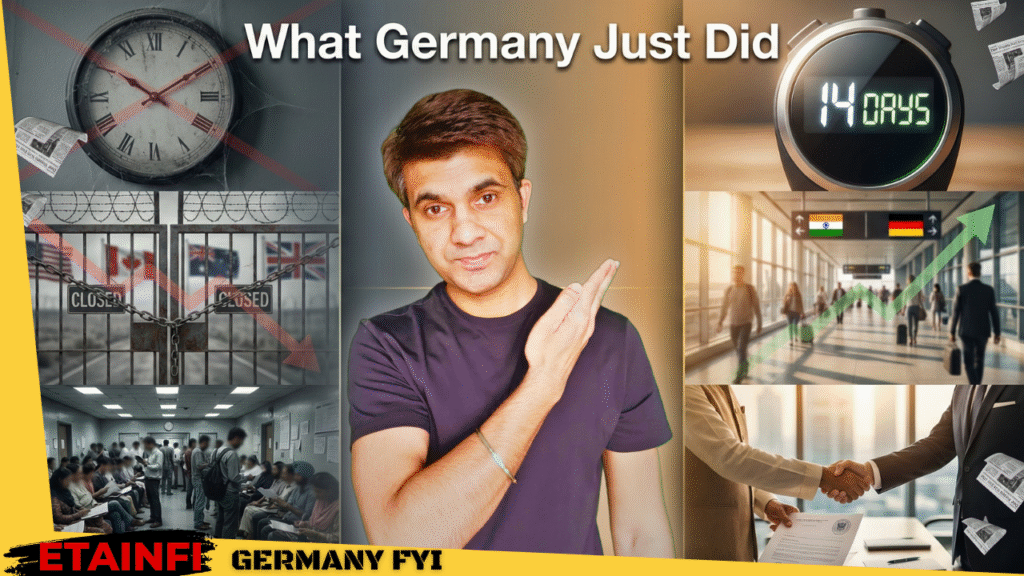
Germany is quietly executing one of the most aggressive talent strategies we’ve seen in years.
While borders are tightening globally, visa pipelines are slowing, and students are being filtered more than welcomed, Germany is doing something unusual — lowering barriers, but only for the right profiles.
If you are planning Germany in 2026, the rules of entry, study, work, and long-term settlement are changing fast.
And one group is being prioritized more clearly than ever.
This is not speculation.
This is strategic career intelligence.
🎥 Prefer to Watch Instead of Read?
If you’d rather see this analysis explained with real examples and timelines, you can also watch the full Germany FYI video breakdown here:
👉 https://youtu.be/87U5GWnBscQ
Why Is Germany Making a Strategic Bet on India Right Now?
Germany is no longer just “open” to Indian students and professionals — it is actively restructuring its migration system around them.
In a recent high-level visit to New Delhi and Ahmedabad, Chancellor Merz finalized 19 bilateral agreements covering skilled migration, education, research, and industrial cooperation. This was not symbolic diplomacy. It was a calculated labor strategy.
Germany’s biggest historical weakness has always been bureaucracy. That friction is now being dismantled specifically for Indian nationals.
Under the new “Focus on India” approach:
- Visa processing times for skilled workers are being cut from months to around two weeks
- Airport transit visa requirements for Indian passport holders have been lifted
The message is direct:
Germany isn’t saying “you’re welcome.”
It’s saying “we need you — now.”
With over 1.4 million job vacancies and an annual target of 400,000 skilled migrants, speed has become a competitive weapon. But faster processing doesn’t reduce competition — it intensifies it.
If you work in IT, healthcare, or engineering, the advantage belongs to those who move early and move clean. Recognition documents, digital files, and applications must be flawless from day one.
Two-week processing only works if nothing breaks.
This “Focus on India” shift — including why faster visas don’t mean easier competition — is explained step by step in the Germany FYI video linked above.
Are Students Being Welcomed — or Recruited With Conditions?
Indian students are now the largest international student group in Germany, crossing 60,000 enrollments — and Germany plans to multiply that number by 2030.
This explains the rapid expansion of German language partner schools in India and the surge in English-taught Master’s programs. But here’s the strategic layer most people miss.
Germany does not see these students as short-term visitors.
It sees them as future workforce and long-term residents, especially as dual citizenship becomes more widely permitted.
The real opportunity is not generic English-taught degrees.
The strongest alignment lies in STEM, green energy, and semiconductor-related programs — areas directly linked to new MoUs and national industrial priorities.
These sectors are not just funded.
They are politically protected and administratively accelerated.
If you are choosing a study path for 2026, anchor it here. This is where post-study residence, employer sponsorship, and long-term security are being quietly optimized.
Is It Easier to Enter German Universities — but Harder to Stay?
Yes — and that contradiction is intentional.
Some universities are lowering NC thresholds for 2026, particularly outside major metro hubs. Germany wants full classrooms.
At the same time, universities such as Jena and Ilmenau are enforcing strict limits on how long students may remain enrolled.
The signal is consistent:
- Entry is becoming more flexible
- Completion is becoming non-negotiable
So don’t just ask “Can I get in?”
Ask “Can I finish on time?”
Choose universities and cities where structure, housing availability, and part-time work realistically support completion — not just admission letters.
Why Are Career Changes Suddenly Normal in Germany?
Germany is no longer treating career changes as failure or delay. Labor shortages have forced a mindset shift, and the system is adapting.
For students and early professionals, this removes a massive psychological burden. Your first degree does not need to be perfect.
What matters now is:
- Skill accumulation
- Applied experience
- Momentum
Werkstudent roles, student jobs, and applied research are no longer optional extras. They are the primary mechanism for career pivots — and Germany is rewarding adaptability more than prestige.
What Are the Real Bottlenecks Nobody Talks About?
The BAföG portal being offline for weeks isn’t just a technical glitch. It reflects strain in student support systems.
At the same time, Germany faces a housing shortage of around 1.4 million apartments, with particularly severe pressure in certain regions.
This changes how smart planning works.
Housing and cash flow are no longer secondary considerations.
They are central constraints.
If a city already struggles with housing, assume competition will intensify — not ease.
What’s the Real Takeaway for 2026?
Germany is lowering barriers selectively, speeding up processes strategically, and rewarding those who align early with its labor priorities.
If you plan clearly, choose the right sectors, finish on time, and move before the crowd, 2026 could be one of the strongest entry windows in years.
At ETAINFI, we help students and professionals decode these shifts early — before policies harden and competition peaks.
If you want weekly career intelligence like this, stay connected with us.