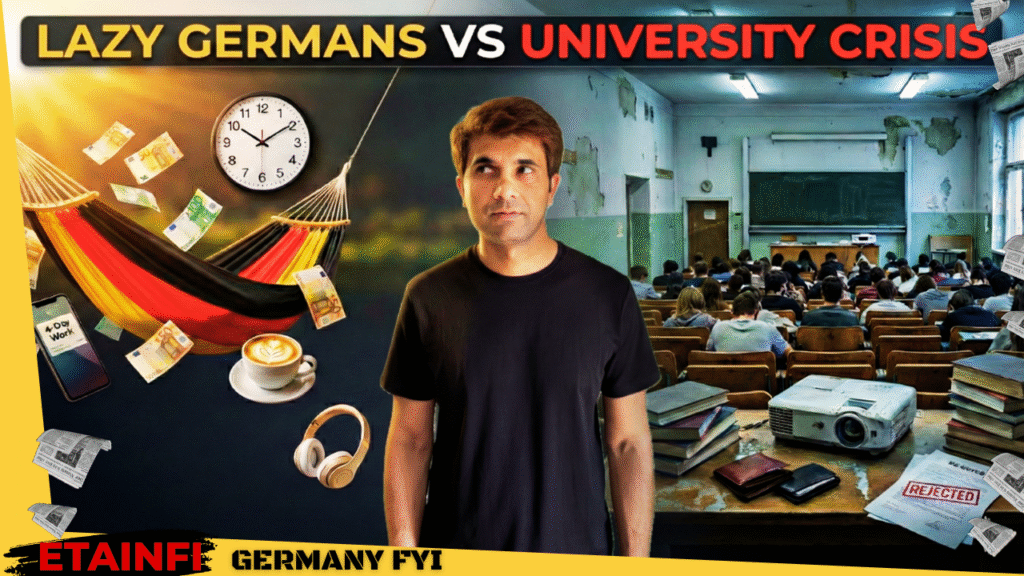
Germany is being talked about everywhere right now — and not always kindly.
Scroll the news or social media and you’ll hear the same claims on repeat: Germans don’t want to work anymore. Gen Z is lazy. Universities are demoralized and falling apart.
But when you step back and actually look at the data, a very different — and far more useful — picture appears.
If you’re studying in Germany, planning your career here, or preparing for your next job interview, this article is for you. Because the real opportunities are hiding behind the noise.
🎥 Prefer watching instead of reading?
This article is based on our latest Germany FYI video, where we break everything down visually with real data and real-life context.
👉 Watch it here: https://youtu.be/irWrik5EWwM
Are Germans Really Working Less — or Just Working Smarter?
The biggest benefit for you: understanding this debate helps you negotiate better contracts and avoid bad career decisions.
Politicians and headlines keep pushing one narrative: Germany needs longer working hours to save the economy. Gen Z is blamed. Flexibility is framed as laziness.
But research tells a calmer, more accurate story.
Yes, average working hours per person are declining — but not because people are refusing to work. The shift is driven by:
- A rise in part-time employment
- A restructuring of how work fits into life
- A stronger focus on output instead of presence
This isn’t a motivation crisis.
It’s a structural transition.
Germany remains one of the most productive countries per hour worked. What’s changing is the expectation that value comes from results — not exhaustion.
How Should This Change the Way You Negotiate Your Job Contract?
The core takeaway: flexibility is no longer a weakness — it’s leverage.
If you’re entering the German job market, don’t let the “lazy generation” stereotype pressure you into accepting poor terms.
Top talent — including international students and graduates — is driving this shift. Employers know it.
The smart move is not asking for less work, but for:
- Clear goals
- Measurable output
- Flexible structures that improve performance
When you position yourself as someone who delivers results instead of clocking hours, many German employers are far more open than the headlines suggest.
The market is changing — quietly, but decisively.
Why Is the Mood at German Universities So Low Right Now?
Here’s the uncomfortable truth: if your university feels drained, it’s not your imagination.
A recent Handelsblatt report describes the mood at German universities as “miserable.”
The reasons are structural:
- Chronic underfunding
- Overcrowded lecture halls
- Administrative overload
- A widening gap between academic theory and real-world jobs
If you’re sitting in a lecture hall right now feeling unmotivated or frustrated — statistically, you are not alone.
But this is only half the story.
If Universities Are Struggling, Why Are Student Startups Increasing?
This is where the opportunity begins.
Despite the negative campus mood, the same reports show something remarkable:
University-based startups in Germany are increasing.
While institutions struggle with bureaucracy, students are building:
- Startups and spin-offs
- Freelance careers
- Consulting projects
- Tech and research-based companies
In other words:
The system feels slow — but the people inside it are moving fast.
And this contradiction is exactly where smart students win.
Where Should You Focus If the Degree Alone Is No Longer Enough?
Your degree is the baseline — not the differentiator.
If you’re studying in Germany and relying only on lectures to secure a job, you’re playing a risky game.
The real value today is found in:
- University incubators
- Entrepreneurship hubs
- Innovation labs
- Founder and startup communities
These are the few places on campus where the “miserable mood” doesn’t apply.
Even if you don’t want to become a CEO, spending time around founders exposes you to:
- Real problem-solving
- Industry connections
- Funding pipelines
- Early job opportunities
That’s where the future is quietly being built.
Are Written Exams in Germany Actually Coming to an End?
Short answer: yes — and AI is accelerating it.
According to Frankfurter Allgemeine Zeitung, German universities are being forced to rethink exams because traditional take-home essays are no longer reliable.
AI tools have changed the rules.
As a result, universities are shifting toward:
- Oral exams
- Presentations
- Live discussions
- Applied problem-solving
This shift feels uncomfortable — but it can work strongly in your favor.
How Should You Change Your Study Strategy Right Now?
The biggest advantage for your future: communication beats memorization.
The new academic reality rewards students who can:
- Explain their thinking clearly
- Defend their ideas verbally
- Apply knowledge in real time
That means it’s time to:
- Stop pure memorization
- Practice structured speaking
- Build confidence in explanations
For non-native German speakers, this shift is especially important. Your ability to communicate confidently will matter more than writing speed or memorized content.
The future of grading in Germany is face-to-face and AI-proof.
What’s the Real Takeaway for Students and Young Professionals in Germany?
Here it is — clearly and honestly:
German institutions may feel slow and grumpy.
But the opportunities are fast, flexible, and everywhere if you know where to look.
- Negotiate for flexibility based on results
- Step outside the lecture hall and into startup spaces
- Start practicing oral presentations early
This is how you stay ahead — not by fighting the system, but by understanding how it’s evolving.
Watch the Full Germany FYI Video (Highly Recommended)
Seeing the headlines, charts, and contrasts visually makes these shifts much easier to understand.
🎥 Full video breakdown:
👉 https://youtu.be/irWrik5EWwM
If you’re making decisions about studying, working, or building a career in Germany, watching this alongside the article will give you the full context.
Moving Forward with ETAINFI
At ETAINFI, our mission is simple:
to help students and professionals cut through confusion, avoid costly mistakes, and build realistic pathways in Germany — step by step.
If you’re studying in Germany, planning to move here, or preparing your next career move, you don’t have to figure it out alone.
Stay informed. Stay adaptable.
And take good care of yourself.
Tschüss 🇩🇪