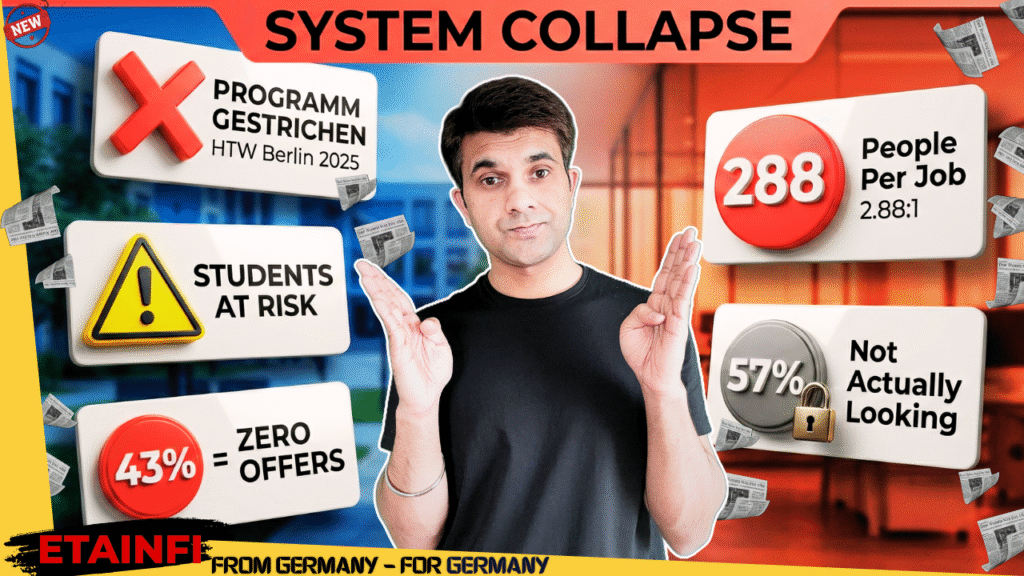
The statistics are terrifying on paper. In Q3 2025, for every 100 open jobs in Germany, there are 288 applicants. That is nearly three people fighting for every single seat—a dramatic spike from just 220 a year ago.
Prefer to watch the full breakdown? Check out the deep dive video here.
If you look at that data and think the problem is simply “too much competition,” you are missing the much bigger, uglier story hiding in the numbers. The reality isn’t that you aren’t good enough; the reality is that the machinery of the German labor market has ground to a halt. From frozen boardrooms to crumbling university budgets, the system is struggling.
But chaos creates opportunity for those who know where to look. Let’s unpack the data, discard the noise, and map out exactly how you can maneuver around the blockage.
Is the Competition Really as Fierce as the Numbers Suggest?
The “army of applicants” you are worried about is largely a statistical mirage. Before you panic about the 288 applicants per job, you need to understand who those applicants actually are.
A recent study from the Bertelsmann Foundation reveals a startling inefficiency in the Bürgergeld (unemployment benefits) system. While official statistics count these recipients as “available for work,” the reality is vastly different. The study indicates that 57% of these individuals are not actually looking for work right now, often due to chronic illness or heavy care duties for family members.
Even worse, the institution designed to bridge the gap—the Jobcenter—is failing to connect. The data shows that 43% of recipients have never received a single job offer, and 38% were never offered training or upskilling.
The “available workforce” is being artificially inflated by people the system has parked and forgotten. They are counted in the statistics, but they are not sitting in the interview room competing with you.
Why Are You Being Ghosted After Great Interviews?
It’s not your resume; it’s “Schockstarre” (Shock Paralysis). If you are sending out applications and facing silence, or if hiring processes are dragging on for months, do not internalize the rejection.
Headhunters across Germany are reporting a phenomenon of Schockstarre in corporate boardrooms. Executives are terrified to make decisions. Between the rapid integration of AI, looming restructuring, and economic layoffs, every new hire feels like a risk. This fear slows down hiring to a crawl.
If you are being ghosted, it is often not because you lacked the skills. It is because your potential boss is literally too scared to sign the contract.
Where Can You Find Leaders Who Are Still Moving?
To succeed in 2025, you must stop relying on the Arbeitsagentur and standard job portals. With a 43% failure rate in the public system and paralyzed corporate leadership at major firms, you need to go around the standard channels.
Your target should be companies that value agility over bureaucracy. Look for:
- Privately held Mittelstand firms: These are the backbone of the German economy and often have clearer ownership structures.
- Agile decision-makers: Companies that openly discuss their rapid adaptation strategies.
- Short decision paths: Teams where the person interviewing you has the actual authority to say “yes.”
You want leaders who are still moving while everyone else is frozen.
Is Your “Safe” Public University Degree Actually at Risk?
While the corporate world freezes, public universities are quietly cutting their losses. The assumption that a big, public university in a major city is the “safe” choice is rapidly becoming outdated.
Berlin provides a stark warning. Public universities are under massive budget pressure, leading to the cancellation of niche but vital programs, such as the unique “Excavation Technology” program at HTW Berlin. If you are planning a specialized degree at a large public university, you must treat budget cuts as a massive red flag.
As big public institutions struggle, students are quietly moving toward stability. They are choosing:
- Private universities like IU International: Where courses are guaranteed to take place, and there is no Numerus Clausus blocking entry.
- “Hidden Gem” public universities: Institutions in towns like Eichstätt-Ingolstadt, which are not facing the same metropolitan chaos and still score incredibly high on student satisfaction.
These places may not have the “fancy” big-city brand, but they aren’t randomly cancelling your future overnight.
How Do You Take Control of Your Career This Week?
The German system is on auto-pilot, and the auto-pilot is broken. The Jobcenter isn’t connecting people, corporate bosses are afraid to hire, and universities are cutting the degrees you might need.
You cannot just send applications and wait. You need to:
- Bypass broken agencies and generic portals.
- Audit your education: Ask if your department is facing budget cuts or if courses are being cancelled.
- Vet your future boss: Look for decision-making courage, not just a brand name.
Be aggressive, be specific, and don’t wait for permission. If you need help mapping out a roadmap that bypasses these systemic failures, ETAINFI is here to guide you from struggling student to established professional.